
|
You entered: stars
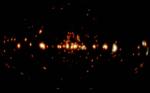 A Mystery in Gamma Rays
3.04.2004
Gamma rays are the most energetic form of light, packing a million or more times the energy of visible light photons. If you could see gamma rays, the familiar skyscape of steady stars would be replaced by some of the most bizarre objects known to modern astrophysics -- and some which are unknown.
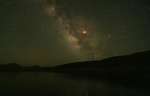 A Total Lunar Eclipse Over Tajikistan
7.11.2022
If the full Moon suddenly faded, what would you see? The answer was recorded in a dramatic time lapse video taken during the total lunar eclipse in 2011 from Tajikistan. During a total lunar eclipse, the Earth moves between the Moon and the Sun, causing the moon to fade dramatically.
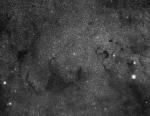 The Snake Nebula in Ophiuchus
24.08.1997
What slithers there? The dark winding lanes visible in part of the constellation Ophiuchus belong to the Snake Nebula. The Snake Nebula is a series of dark absorption clouds made up of Interstellar dust. Interstellar dust grains - composed predominantly of carbon - absorb visible starlight and reradiate much of it in the infrared.
 38 Hours in the M81 Group
10.04.2025
From a garden on planet Earth, 38 hours of exposure with a camera and small telescope produced this cosmic photo of the M81 galaxy group. In fact, the group's dominant galaxy M81 is near the center of the frame sporting grand spiral arms and a bright yellow core.
 A Mystery in Gamma Rays
24.03.2000
Gamma rays are the most energetic form of light, packing a million or more times the energy of visible light photons. What if you could see gamma rays? If you could, the familiar skyscape...
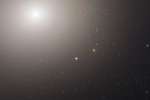 The Densest Galaxy
4.10.2013
The bright core and outer reaches of giant elliptical galaxy M60 (NGC 4649) loom large at the upper left of this sharp close-up from the Hubble Space Telescope. Some 54 million light-years away and 120,000 light-years across, M60 is one of the largest galaxies in the nearby Virgo Cluster.
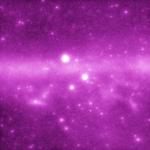 GLAST Gamma Ray Sky Simulation
12.11.1998
This simulated image models the intensities of gamma rays with over 40 million times the energy of visible light, and represents how the sky might appear to the proposed Gamma-ray Large Area Space Telescope (GLAST) after its first year in orbit.
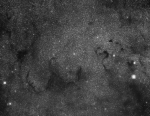 The Snake Nebula in Ophiuchus
11.08.1996
What slithers there? The dark curly lanes visible in part of the constellation Ophiuchus belong to the Snake Nebula. The Snake Nebula is a series of dark absorption clouds. Interstellar dust grains - composed predominantly of carbon - absorb visible starlight and reradiate much of it in the infrared.
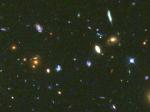 Distant Galaxies
22.06.1997
This Hubble Space Telescope image of a group of faint galaxies "far, far away" is a snap shot of the Universe when it was young. The bluish, irregularly shaped galaxies revealed in the image are up to eight billion light years away and seem to have commonly undergone galaxy collisions and bursts of star formation.
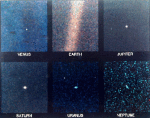 Our Solar System from Voyager
19.08.1995
After taking its spectacular pictures of the outer solar system planets, Voyager 1 looked back at six planets from the inner solar system. Here Venus, Earth, Jupiter, Saturn, Uranus, and Neptune, were all visible across the sky.
|
January February March April May June July August September |
|||||||||||||||||||||||||||||||||||||||||||||||||