
|
You entered: new moon
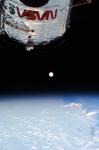 Earth, Moon, Hubble
5.01.2000
The Space Shuttle Discovery Crew was fortunate enough to witness one of the brighter full moon's from orbit two weeks ago during their mission to fix the Hubble Space Telescope. Pictured...
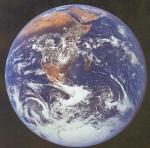 Welcome to Planet Earth
2.01.2005
Welcome to Planet Earth, the third planet from a star named the Sun. The Earth is shaped like a sphere and composed mostly of rock. Over 70 percent of the Earth's surface is water. The planet has a relatively thin atmosphere composed mostly of nitrogen and oxygen.
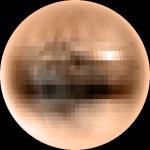 Pluto in True Color
3.09.2006
Pluto is mostly brown. The above picture captures the true colors of Pluto as well as the highest surface resolution so far recovered. Although no spacecraft has yet visited this distant world, the New Horizons spacecraft launched early this year is expected to reach Pluto in 2015.
 APOD: 2026 July 24 Б RCW 86: Historical Supernova Remnant
24.07.2026
In 185 AD, Chinese astronomers recorded the appearance of a new star in the Nanmen asterism. That part of the sky is identified with part of the southern constellation Centaurus on modern star charts.
 Daphnis and the Rings of Saturn
22.02.2017
What's happening to the rings of Saturn? Nothing much, just a little moon making waves. The moon is 8-kilometer Daphnis and it is making waves in the Keeler Gap of Saturn's rings using just its gravity -- as it bobs up and down, in and out.
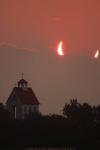 Clouds and the Moon Move to Block the Sun
18.06.2003
High above a small church near Vienna, Austria, clouds and the Moon vied for position in front of the Sun. Such was the case on the ground late last month during a partial eclipse of the Sun visible throughout Europe and Asia.
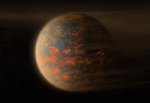 Cancri 55 e: Climate Patterns on a Lava World
5.04.2016
Why might you want to visit super-earth Cancri 55 e? Its extremely hot climate would be a deterrent, as mornings on this world might bring fresh lava flows. Discovered in 2004, the planet Cancri 55 e has twice the diameter of our Earth and about 10 times Earth's mass.
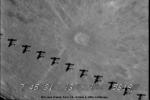 Full Moon Crossing
14.10.2006
On October 6th, a nearly full perigee Moon shone in Earth's night sky. The bright moonlight, accurate planning, and proper equipment resulted in this amazing composite featuring sharp silhouettes of the International Space Station (ISS) as it rapidly crossed (right to left) in front of the lunar disk.
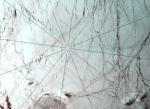 North Pole Below
20.10.2000
Orbiting over the north pole of planet Earth on May 5, the MODIS instrument on-board the Terra spacecraft, recorded this view of the ice cap 700 kilometers below. A radial grid centered on the pole is shown on top of the approximately true color image where each pixel covers about one square kilometer.
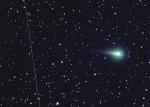 Announcing Comet C 2002 T7 LINEAR
9.02.2004
A newly discovered comet may outshine most stars in the sky by May. Designated Comet C/2002 T7 (LINEAR), the comet was discovered in 2002 October by project LINEAR. Many reports already place the comet as brighter than magnitude 7, meaning that it can now be seen with binoculars.
|
January February March April May June July August September |
|||||||||||||||||||||||||||||||||||||||||||||||||