
|
You entered: full moon
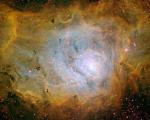 The Lagoon Nebula in Three Colors
6.10.2002
The bright Lagoon Nebula is home to a diverse array of astronomical objects. Particularly interesting sources include a bright open cluster of stars and several energetic star-forming regions. When viewed by eye, cluster light...
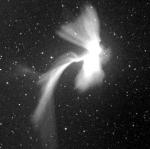 A Leonid Meteor Explodes
22.11.1998
Click on the above image and watch a Leonid meteor explode. The tremendous heat generated by the collision of a small sand-bit moving at 70 kilometers/second with the Earth's upper atmosphere causes the rock-fragment to heat up, glow brightly, and disintegrate.
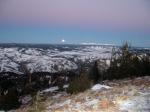 Shadow Set
3.02.2006
A nearly full Moon and planet Earth's shadow set together in this scene captured on January 13th from snowy Mt. Jelm, home of the Wyoming Infrared Observatory. For early morning risers (and late...
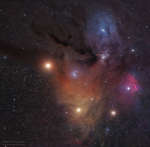 Mars in the Clouds
7.09.2016
Wandering through this stunning field of view, Mars really is in front of these colorful cosmic clouds. The mosaic contructed from telescopic images is about 5 degrees (10 full moons) across. It captures...
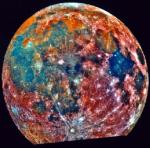 The Colorful Moon
6.01.1998
Do you recognize the Earth's Moon when you see it? The crazy, patchwork appearance of this false color image makes this nearly full view of our Moon's familiar nearside look very strange. The image was taken in 1992 by the Galileo spacecraft enroute to Jupiter.
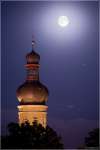 A Galilean Night
23.10.2009
Driving along on a summer evening, near the small town of Weikersheim in southern Germany, photographer Jens Hackmann had to stop. He couldn't resist pointing his camera and telephoto lens at this lovely conjunction of a Full Moon and planet Jupiter looming near the steeple of a local church.
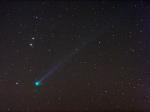 Unexpected Comet Pojmanski Now Visible
5.03.2006
Have you ever seen a comet? Comets bright enough to be visible to the unaided eye appear only every few years. Right now, however, a new comet has brightened unexpectedly and is visible as a faint streak to the unaided northern observer in the eastern morning sky just before sunrise. Binoculars may help.
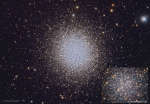 M13: A Great Globular Cluster of Stars
26.07.2016
M13 is one of the most prominent and best known globular clusters. Visible with binoculars in the constellation of Hercules, M13 is frequently one of the first objects found by curious sky gazers seeking celestials wonders beyond normal human vision.
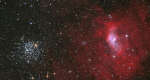 The Bubble and the Star Cluster
24.09.2021
To the eye, this cosmic composition nicely balances the Bubble Nebula at the right with open star cluster M52. The pair would be lopsided on other scales, though. Embedded in a complex of interstellar...
 APOD: 2023 July 26 Б IC 4628: The Prawn Nebula
25.07.2023
South of Antares, in the tail of the nebula-rich constellation Scorpius, lies emission nebula IC 4628. Nearby hot, massive stars, millions of years young, irradiate the nebula with invisible ultraviolet light, stripping electrons from atoms. The electrons eventually recombine with the atoms to produce the visible nebular glow, dominated by the red emission of hydrogen.
|
January February March April May |
|||||||||||||||||||||||||||||||||||||||||||||||||