
|
You entered: star
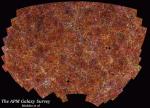 Two Million Galaxies
7.10.2007
Our universe is filled with galaxies. Galaxies -- huge conglomerations of stars, gas, dust -- and mysterious dark matter are the basic building blocks of the large-scale universe. Although distant galaxies move away from each other...
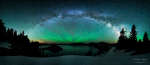 Milky Way Over Crater Lake with Airglow
19.06.2013
How many different astronomical phenomena have come together to create the above vista? Several. First, in the foreground, is Crater Lake -- a caldera created by volcanism on planet Earth about 7,700 years ago. Next, inside the lake, is water.
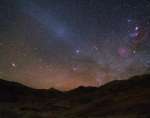 The Gegenschein Over Chile
14.01.2014
Is the night sky darkest in the direction opposite the Sun? No. In fact, a rarely discernable faint glow known as the gegenschein (German for "counter glow") can be seen 180 degrees around from the Sun in an extremely dark sky. The gegenschein is sunlight back-scattered off small interplanetary dust particles.
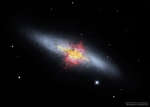 The Central Magnetic Field of the Cigar Galaxy
11.03.2019
Are galaxies giant magnets? Yes, but the magnetic fields in galaxies are typically much weaker than on Earth's surface, as well as more complex and harder to measure. Recently, though, the HAWC+ instrument...
 When Z is for Mars
15.04.2023
A composite of images captured about a week apart from mid August 2022 through late March 2023, this series traces the retrograde motion of ruddy-colored Mars. Progressing from lower right to upper left Mars...
 APOD: 2025 October 1 Б NGC 6960: The Witchs Broom Nebula
1.10.2025
Ten thousand years ago, before the dawn of recorded human history, a new light would suddenly have appeared in the night sky and faded after a few weeks. Today we know this light was from a supernova, or exploding star, and record the expanding debris cloud as the Veil Nebula, a supernova remnant.
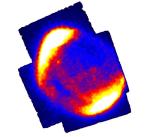 SN 1006: Pieces of the Cosmic Ray Puzzle
2.12.2000
Research balloon flights conducted in 1912 by Austrian physicist Victor Hess revealed that the Earth was constantly bombarded by high energy radiation from space - which came to be called "Cosmic Rays". What are Cosmic Rays and where do they come from?
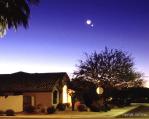 Venus, Moon, and Neighbors
6.04.2000
Rising before the Sun on February 2nd, astrophotographer Joe Orman anticipated this apparition of the bright morning star Venus near a lovely crescent Moon above a neighbor's house in suburban Phoenix, Arizona, USA.
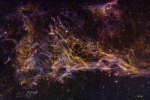 Pickerings Triangle from Kitt Peak
1.07.2008
Wisps like this are all that remain visible of a Milky Way star. About 7,500 years ago that star exploded in a supernova leaving the Veil Nebula, also known as the Cygnus Loop.
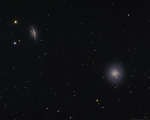 Cetus Galaxies and Supernova
6.12.2018
Large spiral galaxy NGC 1055 at top left joins spiral Messier 77 (bottom right) in this cosmic view toward the aquatic constellation Cetus. The narrowed, dusty appearance of edge-on spiral NGC 1055 contrasts nicely with the face-on view of M77's bright nucleus and spiral arms.
|
January February March April May June July August September |
|||||||||||||||||||||||||||||||||||||||||||||||||