
|
You entered: ionization
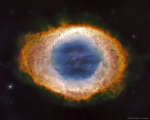 M57: The Ring Nebula
17.04.2018
Except for the rings of Saturn, the Ring Nebula (M57) is probably the most famous celestial band. Its classic appearance is understood to be due to our own perspective, though. The recent mapping...
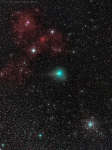 A Charioteer s Comet
1.03.2019
Still racing across planet Earth's night skies, Comet Iwamoto (C/2018 Y1) shares this pretty telescopic field of view with stars and nebulae of northern constellation Auriga, the Charioteer. Captured on February 27, Iwamoto's greenish coma and faint tail appear between a complex of reddish emission nebulae and open star cluster M36 (bottom right).
 APOD: 2020 July 26 Б A Flight through the Hubble Ultra Deep Field
26.07.2020
What would it look like to fly through the distant universe? To find out, a team of astronomers estimated the relative distances to over 5,000 galaxies in one of the most distant fields of galaxies ever imaged: the Hubble Ultra Deep Field (HUDF).
 Sharpless 308: The Dolphin Head Nebula
7.06.2024
Blown by fast winds from a hot, massive star, this cosmic bubble is huge. Cataloged as Sharpless 2-308 it lies some 5,000 light-years away toward the well-trained constellation Canis Major and covers slightly more of the sky than a Full Moon. That corresponds to a diameter of 60 light-years at its estimated distance.
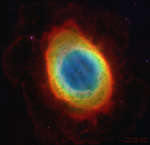 M57: The Ring Nebula from Hubble
17.08.2021
Except for the rings of Saturn, the Ring Nebula (M57) is probably the most famous celestial circle. Its classic appearance is understood to be due to our own perspective, though. The recent mapping...
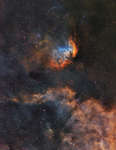 The Tulip and Cygnus X 1
29.07.2021
This tall telescopic field of view looks out along the plane of our Milky Way Galaxy toward the nebula rich constellation Cygnus the Swan. Popularly called the Tulip Nebula, the brightest glowing cloud of interstellar gas and dust above center is also found in the 1959 catalog by astronomer Stewart Sharpless as Sh2-101.
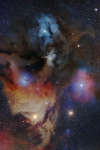 APOD: 2026 July 1 Б The Cotton Candy Clouds of Rho Ophiuchi
1.07.2026
Although they look like cotton candy, you cannot eat these clouds! Taken in Cádiz, Spain, today's image features the Rho Ophiuchi complex, a rich tapestry of young and old astronomical phenomena. This colorful cloud complex is a nearby star-forming region containing hundreds of young stellar objects, including protostars and T Tauri stars.
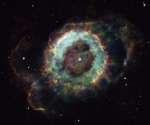 NGC 6369: The Little Ghost Nebula
14.01.2012
This pretty planetary nebula, cataloged as NGC 6369, was discovered by 18th century astronomer William Herschel as he used a telescope to explore the medicinal constellation Ophiucus. Round and planet-shaped, the nebula is also relatively faint and has acquired the popular moniker of Little Ghost Nebula.
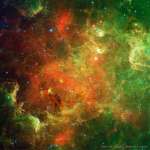 The North America Nebula in Infrared
28.07.2019
The North America Nebula can do what most North Americans cannot -- form stars. Precisely where in the nebula these stars are forming has been mostly obscured by some of the nebula's thick dust that is opaque to visible light.
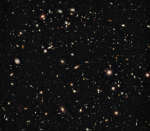 HUDF Infrared: Dawn of the Galaxies
9.12.2009
When did galaxies form? To help find out, the deepest near-infrared image of the sky ever has been taken of the same field as the optical-light Hubble Ultra Deep Field (HUDF) in 2004. The new image was taken this summer by the newly installed Wide Field Camera 3 on the refurbished Hubble Space Telescope.
|
January February March April May June July August September |
|||||||||||||||||||||||||||||||||||||||||||||||||