
|
You entered: hot gas
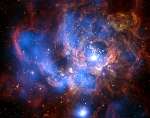 NGC 604: X rays from a Giant Stellar Nursery
5.02.2009
Some 3 million light-years distant in nearby spiral galaxy M33, giant stellar nursery NGC 604 is about 1,300 light-years across, or nearly 100 times the size of the Orion Nebula. In fact, among...
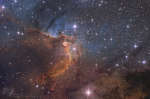 SH2 155: The Cave Nebula
5.11.2014
This colorful skyscape features the dusty Sharpless catalog emission region Sh2-155, the Cave Nebula. In the composite image, data taken through narrowband filters tracks the glow of ionized sulfur, hydrogen, and oxygen atoms in red, green, and blue hues.
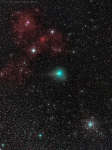 A Charioteer s Comet
1.03.2019
Still racing across planet Earth's night skies, Comet Iwamoto (C/2018 Y1) shares this pretty telescopic field of view with stars and nebulae of northern constellation Auriga, the Charioteer. Captured on February 27, Iwamoto's greenish coma and faint tail appear between a complex of reddish emission nebulae and open star cluster M36 (bottom right).
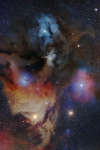 APOD: 2026 July 1 Б The Cotton Candy Clouds of Rho Ophiuchi
1.07.2026
Although they look like cotton candy, you cannot eat these clouds! Taken in Cádiz, Spain, today's image features the Rho Ophiuchi complex, a rich tapestry of young and old astronomical phenomena. This colorful cloud complex is a nearby star-forming region containing hundreds of young stellar objects, including protostars and T Tauri stars.
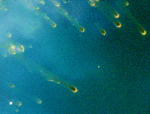 Cometary Knots in the Helix Nebula
16.04.1996
Four hundred fifty light-years from Earth, the wind from a dying, sun-like star produced a planetary nebula popularly known as the Helix. While exploring the Helix's gaseous envelope with the Hubble Space Telescope (HST), astronomers discovered indications of 1,000s of striking "cometary knots" like those shown above.
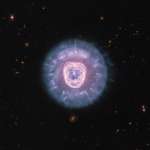 APOD: 2026 August 26 Б JWST Images The Lion's Head Nebula
26.08.2026
Are we looking at the future of our Sun? The James Webb Space Telescope captured todayБs composite image of the LionБs Head Nebula (NGC 2392) with its NIRCam and MIRI instruments. The LionБs Head Nebula is the remnant of a Sun-like star.
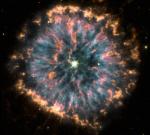 Celebrating Hubble With NGC 6751
16.04.2005
Planetary nebulae can look simple, round, and planet-like in small telescopes. But images from the orbiting Hubble Space Telescope have become well known for showing these fluorescent gas shrouds of dying Sun-like stars to possess a staggering variety of detailed symmetries and shapes.
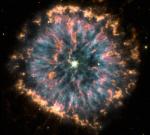 Celebrating Hubble With NGC 6751
7.04.2000
Planetary nebulae do look simple, round, and planet-like in small telescopes. But images from the orbiting Hubble Space Telescope have become well known for showing these fluorescent gas shrouds of dying Sun-like stars to possess a staggering variety of detailed symmetries and shapes.
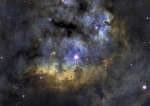 NGC 7822 in Cepheus
16.11.2011
Hot, young stars and cosmic pillars of gas and dust seem to crowd into NGC 7822. At the edge of a giant molecular cloud toward the northern constellation Cepheus, the glowing star forming region lies about 3,000 light-years away. Within the nebula, bright edges and dark shapes are highlighted in this colorful skyscape.
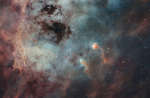 APOD: 2026 March 17 Б The Tadpoles of IC 410
17.03.2026
This telescopic close-up shows off the central regions of otherwise faint emission nebula IC 410, captured under backyard skies. Presented in a Hubble color palette, the image combines visible broadband and narrowband data with data from the near-infrared. Below and right of center are two remarkable inhabitants of the interstellar pond of gas and dust.
|
January February March April May June July August September |
|||||||||||||||||||||||||||||||||||||||||||||||||