
|
You entered: composite image
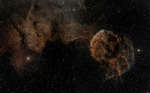 Sharpless 249 and the Jellyfish Nebula
2.12.2014
Normally faint and elusive, the Jellyfish Nebula is caught in this alluring telescopic mosaic. The scene is anchored right and left by two bright stars, Mu and Eta Geminorum, at the foot of the celestial twin while the Jellyfish Nebula is the brighter arcing ridge of emission with dangling tentacles below and right of center.
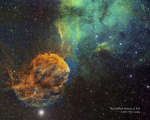 Sharpless 249 and the Jellyfish Nebula
7.01.2017
Normally faint and elusive, the Jellyfish Nebula is caught in this alluring telescopic mosaic. The scene is anchored below by bright star Eta Geminorum, at the foot of the celestial twin, while the Jellyfish Nebula is the brighter arcing ridge of emission with tentacles dangling below and left of center.
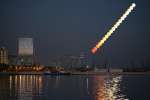 Baku Moonrise
8.12.2012
A Full Moon rises in this waterfront scene. Its colorful, watery reflection is joined by harbor lights and a windowed skyscraper's echo of the western horizon just after sunset. The tantalizing image is a composite of frames recorded at 2 minute intervals on November 28 from the Caspian Sea port city of Baku, Azerbaijan.
 APOD: 2023 August 22 Б The Pistachio Nebula
22.08.2023
This nebula had never been noted before. Newly discovered nebulas are usually angularly small and found by professionals using large telescopes. In contrast, the Pistachio Nebula was discovered by dedicated amateurs and, although faint, is nearly the size of the full Moon.
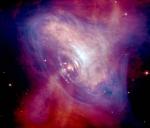 Composite Crab
26.03.2005
(xxxre linkxxx) The Crab Pulsar, a city-sized, magnetized neutron star spinning 30 times a second, lies at the center of this composite image of the inner region of the well-known Crab Nebula. The spectacular...
 A Brighter Comet LINEAR
25.06.2001
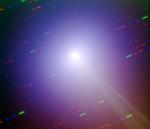
Brighter than ever expected, comet LINEAR -- you know, the one designated C/2001 A2 -- is a sight to see in southern skies. This comet LINEAR first brightened impressively in late March as its active nucleus began to fragment, prompting some speculation that the comet might soon break up completely.
 Seven Sisters Versus California
3.11.2009
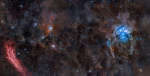
On the upper right, dressed in blue, is the Pleiades. Also known as the Seven Sisters and M45, the Pleiades is one of the brightest and most easily visible open clusters on the sky. The Pleiades contains over 3,000 stars, is about 400 light years away, and only 13 light years across.
 Draconid Meteors Over Spain
19.10.2011
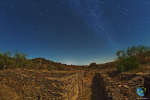
What are those streaks in the sky? They're meteors from the Draconids meteor shower that peaked earlier this month. The above composite image captured numerous meteor streaks over 90 minutes above the Celtic ruins of Capote in Badajoz province, Spain.
 Globular Cluster M3
15.09.2003
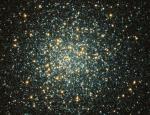
This huge ball of stars predates our Sun. Long before humankind evolved, before dinosaurs roamed, and even before our Earth existed, ancient globs of stars condensed and orbited a young Milky Way Galaxy.
 The Big Picture
11.04.2009
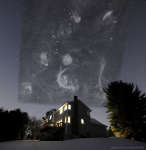
Intricate, glowing nebulae that shine in planet Earth's night sky are beautiful to look at in deep images made with telescopes and sensitive cameras. But they are faint and otherwise invisible to the naked-eye. That makes their relative location and extent on the sky difficult to appreciate.
|
January February March April May June July August September |
|||||||||||||||||||||||||||||||||||||||||||||||||