
|
You entered: Jupiter
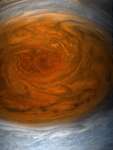 Close up of the Great Red Spot
14.07.2017
On July 11, the Juno spacecraft once again swung near to Jupiter's turbulent cloud tops in its looping 53 day orbit around the Solar System's ruling gas giant. About 11 minutes after perijove 7, its closest approach on this orbit, it passed directly above Jupiter's Great Red Spot.
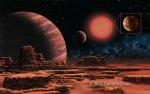 Gliese 876 System Includes Large Terrestrial Planet
14.06.2005
Is our Earth unique? In continuing efforts to answer this question, astronomers have now discovered an Earth-like planet orbiting a distant normal star. Previously over 150 gas-giant planets like Jupiter had been so discovered.
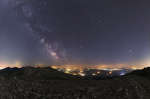 Summer Planets and Milky Way
22.07.2016
Lights sprawl toward the horizon in this night skyscape from Uludag National Park, Bursa Province, Turkey, planet Earth. The stars and nebulae of the Milky Way are still visible though, stretching above the lights on the northern summer night while three other planets shine brightly.
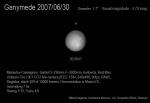 Astronomer s Moon
24.08.2007
Jupiter is an astronomer's planet -- its large size and contrasting global cloud belts and zones allow detailed studies with a range of earthbound telescopes. On the other hand, most telescopic views of Jupiter's moons usually show only featureless, tantalizing points of light hovering near the ruling gas giant.
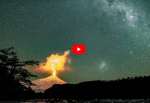 APOD: 2024 July 17 Б Villarrica Volcano Against the Sky
16.07.2024
When Vulcan, the Roman god of fire, swings his blacksmith's hammer, the sky is lit on fire. A recent eruption of Chile's Villarrica volcano shows the delicate interplay between this fire -- actually...
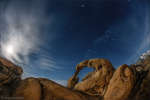 Mobius Arch Moonrise
28.02.2014
Only two days past full, February's moon shines through thin clouds, rising on the left in this fisheye night skyscape. The moonlight illuminates a weathered, rounded foreground in the Alabama Hills, conveniently located east of Mt. Whitney along the Sierra Nevada range in California, USA, planet Earth.
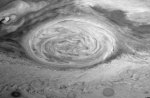 Galileo, Cassini, and the Great Red Spot
2.08.1996
Imagine a hurricane that lasted for 300 years! Jupiter's Great Red Spot indeed seems to be a giant hurricane-like storm system rotating with the Jovian clouds. Observed in 1655 by Italian-French astronomer Jean-Dominique Cassini it is seen here over 300 years later - still going strong - in a mosaic of recent Galileo spacecraft images.
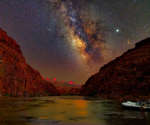 A Sunset Night Sky over the Grand Canyon
3.02.2020
Seeing mountain peaks glow red from inside the Grand Canyon was one of the most incredible sunset experiences of this amateur photographer's life. They appeared even more incredible later, when digitally combined with an exposure of the night sky -- taken by the same camera and from the same location -- an hour later.
 Stars and Planets over Portugal
17.04.2022
The mission was to document night-flying birds -- but it ended up also documenting a beautiful sky. The featured wide-angle mosaic was taken over the steppe golden fields in Mцrtola, Portugal in 2020. From such a dark location, an immediately-evident breathtaking glow arched over the night sky: the central band of our Milky Way galaxy.
 Europa Rotating
15.01.2001
Evidence has been mounting that beneath the vast planes of ice that cover Europa lies water -- liquid oceans that might be home to alien life. The smallest of Jupiter's Galilean Moons (which include Io, Ganymede, and Callisto), Europa's deep interior is composed of mostly of silicate rock.
|
January February March April May June July August |
||||||||||||||||||||||||||||||||||||||||||||||||||||||||