
|
You entered: solar rotation
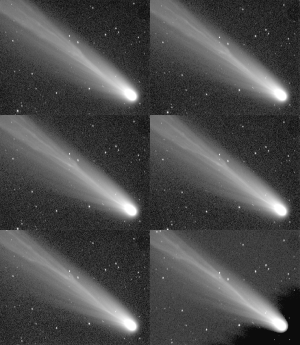 Tail Wags of Comet Ikeya Zhang
15.05.2002
As Comet Ikeya-Zhang approached the Sun two months ago, it developed a complex blue ion tail. The tail was composed of ions that boiled off the nucleus and were pushed away from the Sun by the out-flowing fast-moving particles of the solar wind.
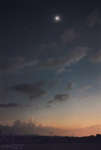 A Total Solar Eclipse of Saros 145
10.08.2017
A darkened sky holds bright planet Venus, the New Moon in silhouette, and the shimmering corona of the Sun in this image of a total solar eclipse. A composite of simultaneous telephoto and wide angle frames it was taken in the path of totality 18 years ago, August 11, 1999, near Kastamonu, Turkey.
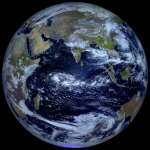 Equinox Earth
28.09.2013
From a geostationary orbit 36,000 kilometers above the equator, Russian meteorological satellite Elektro-L takes high-resolution images our fair planet every 30 minutes. But only twice a year, during an Equinox, can it capture an image like this one, showing an entire hemisphere bathed in sunlight.
 Jupiter over 2 Hours and 30 Minutes
18.01.2024
Jupiter, our Solar System's ruling gas giant, is also the fastest spinning planet, rotating once in less than 10 hours. The gas giant doesn't rotate like a solid body though.
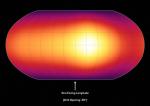 HD 189733b: Hot Jupiter
12.05.2007
HD 189733b is a Jupiter-sized planet known to orbit a star some 63 light-years away. But while the distant world is approximately the size of Jupiter, its close-in orbit makes it much hotter than our solar system's ruling gas giant.
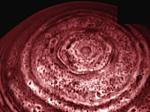 A Mysterious Hexagonal Cloud System on Saturn
3.04.2007
Why would clouds form a hexagon on Saturn? Nobody is yet sure. Originally discovered during the Voyager flybys of Saturn in the 1980s, nobody has ever seen anything like it anywhere else in the Solar System.
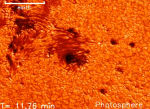 Orange Sun Oozing
6.11.2011
The Sun's surface keeps changing. The above movie shows how the Sun's surface oozes during a single hour. The Sun's photosphere has thousands of bumps called granules and usually a few dark depressions called sunspots.
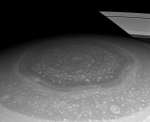 Saturns Hexagon and Rings
20.02.2013
Why would clouds form a hexagon on Saturn? Nobody is sure. Originally discovered during the Voyager flybys of Saturn in the 1980s, nobody has ever seen anything like it anywhere else in the Solar System.
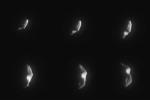 NEAR to Asteroid Eros
4.02.2000
On December 23, 1998 the Near Earth Asteroid Rendezvous (NEAR) spacecraft flew by asteroid 433 Eros. The robotic spacecraft was intended to brake and orbit Eros, but an unexpected shutdown of its main engine caused this plan to be aborted.
 Aurora over Maine
17.09.2014
It has been a good week for auroras. Earlier this month active sunspot region 2158 rotated into view and unleashed a series of flares and plasma ejections into the Solar System during its journey across the Sun's disk.
|
January February March April May June July August |
||||||||||||||||||||||||||||||||||||||||||||||||||||||||