
|
You entered: red dwarf
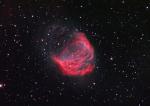 The Medusa Nebula
23.11.2007
Braided, serpentine filaments of glowing gas suggest this nebula's popular name, The Medusa Nebula. Also known as Abell 21, this Medusa is an old planetary nebula some 1,500 light-years away in the constellation Gemini. Like its mythological namesake, the nebula is associated with a dramatic transformation.
 The Medusa Nebula
25.10.2012
Braided, serpentine filaments of glowing gas suggest this nebula's popular name, The Medusa Nebula. Also known as Abell 21, this Medusa is an old planetary nebula some 1,500 light-years away in the constellation Gemini. Like its mythological namesake, the nebula is associated with a dramatic transformation.
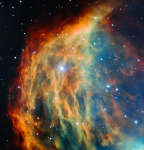 The Medusa Nebula
12.06.2015
Braided, serpentine filaments of glowing gas suggest this nebula's popular name, The Medusa Nebula. Also known as Abell 21, this Medusa is an old planetary nebula some 1,500 light-years away along the southern border of the constellation Gemini. Like its mythological namesake, the nebula is associated with a dramatic transformation.
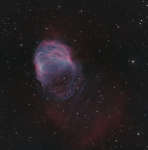 The Medusa Nebula
17.03.2023
Braided and serpentine filaments of glowing gas suggest this nebula's popular name, The Medusa Nebula. Also known as Abell 21, this Medusa is an old planetary nebula some 1,500 light-years away in the constellation Gemini. Like its mythological namesake, the nebula is associated with a dramatic transformation.
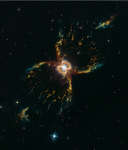 The Shape of the Southern Crab
24.04.2019
The symmetric, multi-legged appearance of the Southern Crab Nebula is certainly distinctive. About 7,000 light-years distant toward the southern sky constellation Centaurus, its glowing nested hourglass shapes are produced by the remarkable symbiotic binary star system at its center.
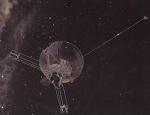 Pioneer 10: The First 6 Billion Miles
20.06.1998
Q: What was made by humans and is 6.5 billion miles away? A: Pioneer 10 - and last year was the 25th anniversary of its launch. More than 9.5 light-hours distant, Pioneer 10 is presently about twice as far from the Sun as Pluto, bound for interstellar space at 28,000 miles per hour.
 APOD: 2024 February 12 Б HFG1 & Abell 6: Planetary Nebulae
12.02.2024
Planetary nebulae like Heckathorn-Fesen-Gull 1 (HFG1) and Abell 6 in the constellation Cassiopeia are remnants from the last phase of a medium sized star like our Sun. In spite of their shapes, planetary nebulae have nothing in common with actual planets.
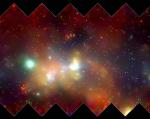 X Ray Milky Way
10.01.2002
If you had x-ray vision, the center regions of our galaxy would not be hidden from view by immense cosmic dust clouds opaque to visible light. Instead, the Milky Way toward Sagittarius might look something like this stunning mosaic of images from the orbiting Chandra Observatory.
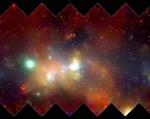 X Ray Milky Way
12.07.2003
If you had x-ray vision, the center regions of our Galaxy would not be hidden from view by the immense cosmic dust clouds opaque to visible light. Instead, the Milky Way toward Sagittarius might look something like this stunning mosaic of images from the orbiting Chandra Observatory.
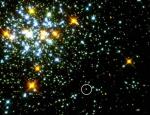 NGC 1818: Pick A Star
15.04.1998
This is NGC 1818, a youthful, glittering cluster of 20,000 stars residing in the Large Magellanic Cloud, 164,000 light-years away. Pick a star. Any star. Astronomers might pick the unassuming bluish-white one (circled) which appears to be a hot newly formed white dwarf star. What makes it so interesting?
|
January February March April May June July August September October |
|||||||||||||||||||||||||||||||||||||||||||||||||