
|
You entered: neutron
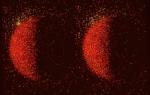 X Ray Moon and X Ray Star
9.09.2000
An x-ray star winks out behind the Moon in these before (left) and after views of a lunar occultation of the galactic x-ray source designated GX5-1. The false color images were made using data from the ROSAT (ROentgen SATellite), orbiting observatory.
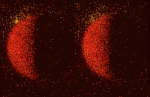 X-ray Moon and X-ray Star
27.02.1996
An X-ray star winks out behind the Moon in these before and after views of a lunar occultation of the galactic X-ray source designated GX5-1. The false color images were made using data...
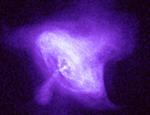 The Crab Nebula in X Rays
29.09.1999
Why does the Crab Nebula still glow? In the year 1054 A.D. a supernova was observed that left a nebula that even today glows brightly in every color possible, across the entire electromagnetic spectrum. At the nebula's center is an ultra-dense neutron star that rotates 30 times a second.
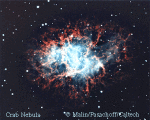 M1: The Exploding Crab Nebula
22.11.1995
The Crab Nebula resulted from a star that exploded - a supernova. The outer layers of the star were thrown violently into space, while the inner core collapsed to form a neutron star. This neutron...
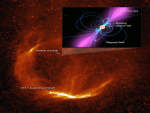 A Dark Pulsar in CTA 1
21.10.2008
Where's the pulsar? Previously, the nebula CTA 1 showed an expanding supernova remnant, a jet, and a point source expected to be a pulsar -- a rotating neutron star producing pulses at radio energies. But no radio pulses were detected.
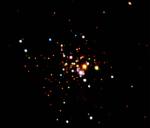 X Ray Stars of 47 Tuc
21.07.2005
Visible light images show the central region of globular cluster 47 Tucanae is closely packed, with stars less than a tenth of a light-year apart. This Chandra false-color x-ray view of central...
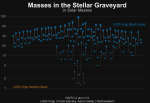 Fifty Gravitational Wave Events Illustrated
4.11.2020
Over fifty gravitational wave events have now been detected. These events mark the distant, violent collisions of two black holes, a black hole and a neutron star, or two neutron stars. Most of the 50 events were detected in 2019 by the LIGO gravitational wave detectors in the USA and the VIRGO detector in Europe.
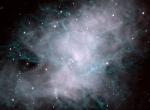 The Crab Nebula in Blue and White
11.07.2000
The Crab Nebula is a complex shell of expanding gas. The Crab Nebula formed from a star that was seen to explode in a supernova about 1000 years ago. This two color composite image taken with the WIYN 3.5-meter telescope shows in great detail filamentary structure of the glowing hydrogen gas.
 APOD: 2025 December 29 Б M1: The Crab Nebula
29.12.2025
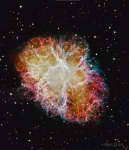
This is the mess that is left when a star explodes. The Crab Nebula, the result of a supernova seen in 1054 AD, is filled with mysterious filaments. The filaments are not only tremendously...
 Short Gamma Ray Bursts Localized
17.10.2005
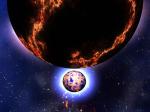
What causes gamma-ray bursts? The most energetic type of explosions known in the cosmos has been an enigma since discovered over 30 years ago. It now appears that there may not be one unique type of progenitor.
|
January February March April May June July August September October |
|||||||||||||||||||||||||||||||||||||||||||||||||