
|
You entered: dust cloud
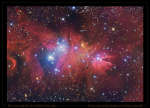 A Fox Fur, a Unicorn, and a Christmas Tree
6.04.2010
What do the following things have in common: a cone, the fur of a fox, and a Christmas tree? Answer: they all occur in the constellation of the unicorn (Monoceros). Pictured above...
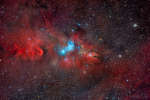 Fox Fur, Unicorn, and Christmas Tree
26.12.2020
Clouds of glowing hydrogen gas fill this colorful skyscape in the faint but fanciful constellation Monoceros, the Unicorn. A star forming region cataloged as NGC 2264, the complex jumble of cosmic gas and dust...
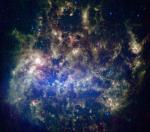 The Large Magellanic Cloud in Infrared
4.09.2006
Where does dust collect in galaxies? To help find out, a team of researchers took the most detailed image ever of gas clouds and dust in the neighboring Large Magellanic Cloud (LMC) galaxy.
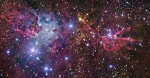 Fox Fur, a Unicorn, and a Christmas Tree
25.12.2008
Clouds of glowing hydrogen gas fill this colorful skyscape in the faint but fanciful constellation Monoceros, the Unicorn. A star forming region cataloged as NGC 2264, the complex jumble of cosmic gas and dust...
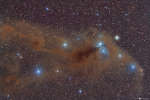 Stars and Dust Across Corona Australis
27.06.2011
Cosmic dust clouds sprawl across a rich field of stars in this sweeping telescopic vista near the northern boundary of Corona Australis, the Southern Crown. Probably less than 500 light-years away and effectively blocking...
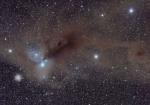 Stars and Dust in Corona Australis
15.07.2004
A cosmic dust cloud sprawls across a rich field of stars in this gorgeous wide field telescopic vista looking toward Corona Australis, the Southern Crown. Probably less than 500 light-years away and effectively blocking...
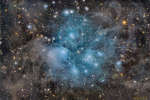 The Pleiades Deep and Dusty
25.02.2014
The well known Pleiades star cluster is slowly destroying part of a passing cloud of gas and dust. The Pleiades is the brightest open cluster of stars on Earth's sky and can be seen from almost any northerly location with the unaided eye.
 APOD: 2024 January 29 Б The Pleiades: Seven Dusty Sisters
29.01.2024
The well-known Pleiades star cluster is slowly destroying part of a passing cloud of gas and dust. The Pleiades is the brightest open cluster of stars on Earth's sky and can be seen from almost any northerly location with the unaided eye.
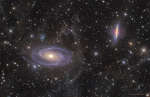 M81 versus M82
25.09.2013
Here in the Milky Way galaxy we have astronomical front row seats as M81 and M82 face-off, a mere 12 million light-years away. Locked in a gravitational struggle for the past billion years or so, the two bright galaxies are captured in this deep telescopic snapshot, constructed from 25 hours of image data.
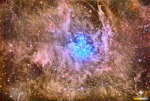 The Pleiades Deep and Dusty
14.11.2017
The well-known Pleiades star cluster is slowly destroying part of a passing cloud of gas and dust. The Pleiades is the brightest open cluster of stars on Earth's sky and can be seen from almost any northerly location with the unaided eye.
|
January February March April May June July August September |
|||||||||||||||||||||||||||||||||||||||||||||||||