
|
You entered: Uranus moon
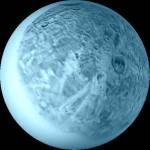 Hamlet of Oberon
27.02.1999
What's in a name? Since 1919, the International Astronomical Union has been charged with the task of establishing "conventional" nomenclature for planets, satellites, and surface features. For the remote Uranian system of moons, namesakes from Shakespearean works have been chosen.
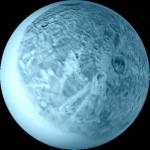 Hamlet of Oberon
31.01.1997
What's in a name? Since 1919, the International Astronomical Union has been charged with the task of establishing "conventional" nomenclature for planets, satellites, and surface features. For the remote Uranian system of moons, namesakes from Shakespearean works have been chosen.
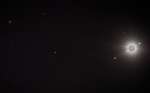 Two Planet Opposition
8.10.2010
In late September, two planets were opposite the Sun in Earth's sky, Jupiter and Uranus. Consequently closest to Earth, at a distance of only 33 light-minutes and 2.65 light-hours respectively, both were good targets for telescopic observers.
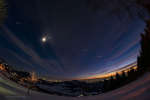 Planetary Alignment over Italy
19.12.2021
It is not a coincidence that planets line up. That's because all of the planets orbit the Sun in (nearly) a single sheet called the plane of the ecliptic. When viewed from inside that plane -- as Earth dwellers are likely to do -- the planets all appear confined to a single band.
 New Moons For Saturn
3.11.2000
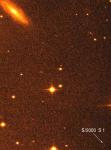
Which planet has the most moons? For now, it's Saturn. Four newly discovered satellites bring the ringed planet's total to twenty-two, just edging out Uranus' twenty-one for the most known moons in the solar system. Of course, the newfound Saturnian satellites are not large and photogenic.
 Uranian Moons, Rings, And Clouds
26.11.1997
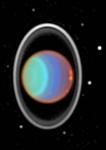
The giant planet Uranus is faint and featureless when viewed in visible light. But this pair of near-infrared mosaics from the Hubble Space Telescope's NICMOS camera reveals moons, rings, and clouds of this distant gas planet.
 Jupiter's Rings
2.08.1995
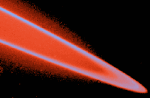
Astronomers using NASA's Voyager spacecraft to search for a ring system around Jupiter discovered these faint rings in 1979. Unlike Saturn's bright rings which are composed of chunks of rock and ice, Jupiter's rings appear to consist of fine particles of dust.
 APOD: 2023 January 2 Б After Sunset Planet Parade
2.01.2023
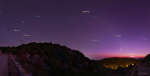
Look up tonight and see a whole bunch of planets. Just after sunset, looking west, planets Venus, Saturn, Jupiter and Mars will all be simultaneously visible. Listed west to east, this planetary lineup will have Venus nearest the horizon, but setting shortly after the Sun.
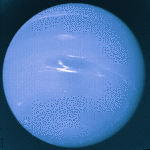 Neptune: Big Blue Giant
21.02.1998
This picture was taken by the Voyager 2 spacecraft in 1989 - the only spacecraft ever to visit Neptune. Neptune will be the farthest planet from the Sun until 1999, when the elliptical orbit of Pluto will cause it to once again resume this status.
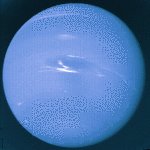 Neptune: Big Blue Giant
17.08.1995
This picture was taken by the Voyager 2 spacecraft in 1986 - the only spacecraft ever to visit Neptune. Neptune will be the farthest planet from the Sun until 1999, when the elliptical orbit of Pluto will cause it to once again resume this status.
|
January February March April May June July August September |
|||||||||||||||||||||||||||||||||||||||||||||||||