
|
You entered: Puppis
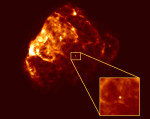 Supernova Remnant and Neutron Star
25.04.1998
A massive star ends life as a supernova, blasting its outer layers back to interstellar space. The spectacular death explosion is initiated by the collapse of what has become an impossibly dense stellar core. However, this core is not necessarily destroyed.
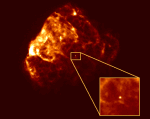 Supernova Remnant and Neutron Star
14.11.1996
A massive star ends life as a supernova, blasting its outer layers back to interstellar space. The spectacular death explosion is initiated by the collapse of what has become an impossibly dense stellar core. However, this core is not necessarily destroyed.
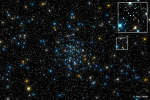 M46 Plus Two
17.04.2015
Galactic or open star clusters are young. These swarms of stars are born together near the plane of the Milky Way, but their numbers steadily dwindle as cluster members are ejected by galactic tides and gravitational interactions. In fact, this bright open cluster, known as M46, is around 300 million years young.
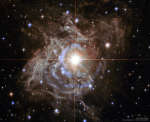 Nearby Cepheid Variable RS Pup
29.08.2018
In the center is one of the most important stars on the sky. This is partly because, by coincidence, it is surrounded by a dazzling reflection nebula. Pulsating RS Puppis, the brightest star in the image center, is some ten times more massive than our Sun and on average 15,000 times more luminous.
 Hartley 2 Star Cluster Tour
2.12.2010
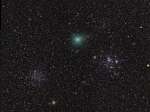
Early in November, small but active Comet Hartley 2 (103/P Hartley) became the fifth comet imaged close-up by a spacecraft from planet Earth. Continuing its own tour of the solar system with a 6 year orbital period, Hartley 2 is now appearing in the nautical constellation Puppis.
 Nearby Cepheid Variable RS Pup
9.09.2013
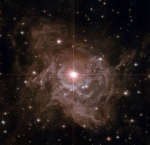
It is one of the most important stars in the sky. This is partly because, by coincidence, it is surrounded by a dazzling reflection nebula. Pulsating RS Puppis, the brightest star in the image center, is some ten times more massive than our Sun and on average 15,000 times more luminous.
 ROSAT Explores The X-Ray Sky
8.10.1996
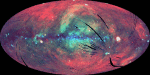
Launched in 1990, the orbiting ROSAT observatory explored the Universe by viewing the entire sky in x-rays - photons with about 1,000 times more energy than visible light. This ROSAT survey produced the sharpest, most sensitive image of the x-ray sky to date.
|
January February |
|||||||||||||||||||||||||||||||||||||||||||||||||