
|
You entered: Martian moon
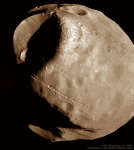 Phobos: Doomed Moon of Mars
25.11.2018
This moon is doomed. Mars, the red planet named for the Roman god of war, has two tiny moons, Phobos and Deimos, whose names are derived from the Greek for Fear and Panic. The origin of the Martian moons is unknown, though, with a leading hypothesis holding that they are captured asteroids.
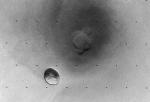 Phobos Over Mars
13.03.1999
Hurtling through space a mere 3,000 miles above the Martian surface, the diminutive moon Phobos (below and left of center) was imaged against the backdrop of a large shield volcano by the Viking 2 Orbiter in 1977.
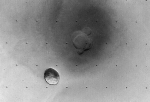 Phobos Over Mars
15.10.1996
Hurtling through space a mere 3,000 miles above the Martian surface, the diminutive moon Phobos (below and left of center) was imaged against the backdrop of a large shield volcano by the Viking 2 Orbiter in 1977.
 Tardigrade in Moss
26.03.2017
Is this an alien? Probably not, but of all the animals on Earth, the tardigrade might be the best candidate. That's because tardigrades are known to be able to go for decades without...
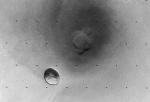 Phobos Over Mars
29.11.2003
Hurtling through space a mere 3,000 miles above the Martian surface, the diminutive moon Phobos (below and left of center) was imaged against the backdrop of a large shield volcano by the Viking 2 Orbiter in 1977.
 APOD: 2024 September 9 Б Mars: Moon, Craters, and Volcanos
9.09.2024
If you could fly over Mars, what might you see? The featured image shows exactly this in the form of a Mars Express vista captured over a particularly interesting region on Mars in July. The picture's most famous feature is Olympus Mons, the largest volcano in the Solar System, visible on the upper right.
 Tardigrade in Moss
6.03.2013
Is this an alien? Probably not, but of all the animals on Earth, the tardigrade might be the best candidate. That's because tardigrades are known to be able to go for decades without...
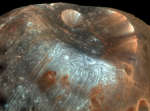 Stickney Crater
18.01.2013
Stickney Crater, the largest crater on the martian moon Phobos, is named for Chloe Angeline Stickney Hall, mathematician and wife of astronomer Asaph Hall. Asaph Hall discovered both the Red Planet's moons in 1877.
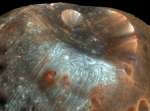 Stickney Crater
10.04.2008
Stickney Crater, the largest crater on the martian moon Phobos, is named for Chloe Angeline Stickney Hall, mathematician and wife of astronomer Asaph Hall. Asaph Hall discovered both the Red Planet's moons in 1877.
 Stickney Crater
8.07.2023
Stickney Crater, the largest crater on the martian moon Phobos, is named for Chloe Angeline Stickney Hall, mathematician and wife of astronomer Asaph Hall. Asaph Hall discovered both the Red Planet's moons in 1877.
|
January February March April May June July August September |
|||||||||||||||||||||||||||||||||||||||||||||||||