
|
You entered: M 1
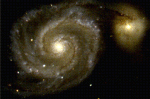 M51: The Whirlpool Galaxy
18.12.1995
The Whirlpool Galaxy is frequently given as an example of a galaxy with classic spiral design. At only 15 million light years distant, M51, also cataloged as NGC 5194, is also one of the brighter and more picturesque galaxies on the sky.
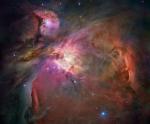 Orion Nebula, The Hubble View
19.01.2006
Few cosmic vistas excite the imagination like the Orion Nebula. Also known as M42, the nebula's glowing gas surrounds hot young stars at the edge of an immense interstellar molecular cloud only 1,500 light-years away.
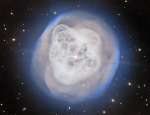 APOD: 2026 May 28 Б NGC 1514: The Crystal Ball Nebula
28.05.2026
What do you see in this crystal ball? The featured image shows NGC 1514, known as the Crystal Ball Nebula, observed by the Gemini North telescope on Maunakea, in Hawai'i. NGC 1514 is 1,500 light-years away and was discovered by William Herschel in 1790.
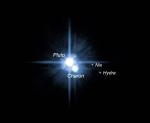 Nix and Hydra
24.06.2006
Discovered in mid-2005, Pluto's small moons were provisionally designated S/2005 P1 and S/2005 P2. They have now been officially christened Nix and Hydra. Compared to Pluto and its large moon Charon...
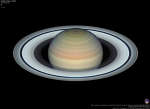 Saturn near Opposition
17.06.2017
Saturn reached its 2017 opposition on June 16. Of course, opposition means opposite the Sun in Earth's sky and near opposition Saturn is up all night, at its closest and brightest for the year.
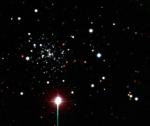 Palomar 13 s Last Stand
25.01.2003
Globular star cluster Palomar 13 has roamed the halo of our Milky Way Galaxy for the last 12 billion years. The apparently sparse cluster of stars just left of center in this composite color digital image, it is one of the smallest, faintest globular clusters known.
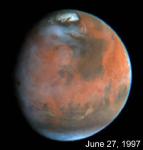 Mars: A Journey's End
3.07.1997
Mars Pathfinder is nearing the end of its 7 month journey. The robot spacecraft is scheduled to use parachutes, rockets, and airbags to "bouncedown" on the red planet tomorrow - July 4th. This Hubble Space Telescope image of Mars was taken a few days ago to check on the weather.
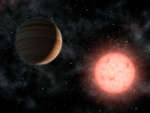 VB 10: A Large Planet Orbiting a Small Star
3.06.2009
Can a planet be as large as the star that it orbits? Recent observations have discovered that nearby Van Biesbroeck's star might have just such a large planet. Although VB 10 lies only...
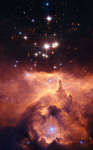 Massive Stars in Open Cluster Pismis 24
26.10.2008
How massive can a normal star be? Estimates made from distance, brightness and standard solar models had given one star in the open cluster Pismis 24 over 200 times the mass of our Sun, making it a record holder. This star is the brightest object located just above the gas front in the above image.
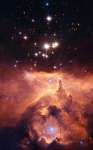 NGC 6357s Cathedral to Massive Stars
18.11.2012
How massive can a normal star be? Estimates made from distance, brightness and standard solar models had given one star in the open cluster Pismis 24 over 200 times the mass of our Sun, nearly making it the record holder.
|
January February March April May June July August September |
|||||||||||||||||||||||||||||||||||||||||||||||||