
|
You entered: Huygens probe
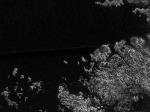 Liquid Sea on Saturns Titan
30.05.2007
What is this vast dark region on Titan? Quite possible a sea of liquid hydrocarbons. The region was imaged earlier this month when the robotic Cassini spacecraft swooped past Saturn's cloudy moon and illuminated part of it with radar.
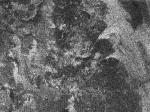 A Radar View of Titan
24.11.2004
Where are Titan's craters? Throughout our Solar System's five billion-year history, dangerous rocks and chunks of ice have continually slammed into planets and moons - usually creating numerous long lasting impact craters. When the robot spacecraft Cassini swooped past Saturn's moon Titan last month, however, radar images showed few craters.
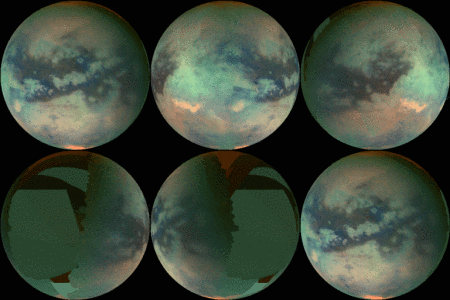 Rotating Titan in Infrared Light
15.02.2006
Titan is one of the strangest places in our Solar System. The only moon known with thick clouds, this unusual satellite of Saturn shows evidence of evaporating lakes created by methane rain. The clouds...
 APOD: 2025 November 30 Б The Surface of Titan from Huygens
30.11.2025
If you could stand on Titan -- what would you see? The featured color viewa from Titan gazes across an unfamiliar and distant landscape on Saturn's largest moon. The scene was recorded by ESA's Huygens probe in 2005 after a 2.5-hour descent through a thick atmosphere of nitrogen laced with methane.
 Voyager Views Titan s Haze
5.09.2002
Launched in 1977, 25 years ago today, the Voyager 1 spacecraft's historic tour of the outer Solar System took it past Saturn in late 1980. On November 12, 1980, Voyager 1 recorded this view looking across the edge of Titan, Saturn's largest moon, from a distance of about 22,000 kilometers.
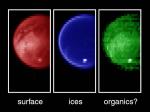 Titan from Cassini in Infrared
6.07.2004
Could life exist under the smog of Titan? If not, what is creating all of the methane? To help answer these questions, the largest and most mysterious moon of Saturn got a quick first look from the Cassini robot spacecraft soon after entering orbit around the giant planet last week.
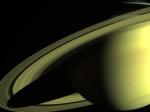 24 Million Kilometers to Saturn
31.05.2004
Next stop: Saturn. The Cassini-Huygens spacecraft is approaching Saturn and will fire its engines to break into orbit around the ringed giant on July 1. The robot spacecraft was launched in 1997 and rounded Jupiter in 2001.
|
January February March April May June July August September |
|||||||||||||||||||||||||||||||||||||||||||||||||