
|
You entered: Gemini telescope
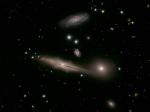 Galaxy Group HCG 87
31.07.2003
Posing for this cosmic family photo are the galaxies of HCG (Hickson Compact Group) 87, about four hundred million light-years distant toward the amphibious constellation Capricornus. The large edge-on spiral near picture center...
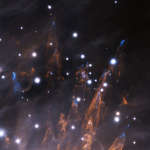 The Orion Bullets
10.01.2013
Cosmic bullets pierce the outskirts of the Orion Nebula some 1500 light-years distant in this sharp infrared close-up. Blasted out by energetic massive star formation the bullets, relatively dense, hot gas clouds about ten times the size of Pluto's orbit, are blue in the false color image.
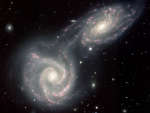 The Colliding Spiral Galaxies of Arp 271
21.07.2008
What will become of these galaxies? Spiral galaxies NGC 5426 and NGC 5427 are passing dangerously close to each other, but each is likely to survive this collision. Most frequently when galaxies collide, a large galaxy eats a much smaller galaxy.
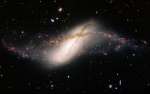 Polar Ring Galaxy NGC 660
10.11.2012
NGC 660 is featured in this cosmic snapshot, a sharp composite of broad and narrow band filter image data from the Gemini North telescope on Mauna Kea. Over 20 million light-years away and swimming within the boundaries of the constellation Pisces, NGC 660's peculiar appearance marks it as a polar ring galaxy.
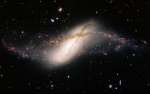 Polar Ring Galaxy NGC 660
7.11.2014
NGC 660 is featured in this cosmic snapshot, a sharp composite of broad and narrow band filter image data from the Gemini North telescope on Mauna Kea. Over 20 million light-years away and swimming within the boundaries of the constellation Pisces, NGC 660's peculiar appearance marks it as a polar ring galaxy.
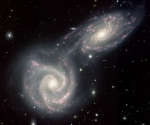 The Colliding Spiral Galaxies of Arp 271
25.08.2013
What will become of these galaxies? Spiral galaxies NGC 5426 and NGC 5427 are passing dangerously close to each other, but each is likely to survive this collision. Typically when galaxies collide, a large galaxy eats a much smaller galaxy.
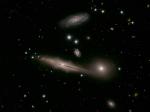 Galaxy Group HCG 87
16.07.2005
Posing for this cosmic family photo are the galaxies of HCG (Hickson Compact Group) 87, about four hundred million light-years distant toward the amphibious constellation Capricornus. The large edge-on spiral near picture center...
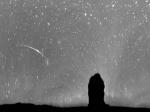 A Taurid Meteor Fireball
15.11.2005
Have you ever seen a very bright meteor? Unexpected, this year's Taurid meteor shower resulted in numerous reports of very bright fireballs during the nights surrounding Halloween. Pictured above, a fireball that momentarily rivaled the brightness of the full Moon was caught over Cerro Pachon, Chile by a continuous sky monitor on November 1.
 The Southern Cliff in the Lagoon
15.05.2021
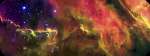
Undulating bright ridges and dusty clouds cross this close-up of the nearby star forming region M8, also known as the Lagoon Nebula. A sharp, false-color composite of narrow band visible and broad band near-infrared...
 The Eskimo Nebula from Hubble
7.04.2002
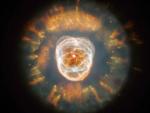
In 1787, astronomer William Herschel discovered the Eskimo Nebula. From the ground, NGC 2392 resembles a person's head surrounded by a parka hood. In 2000, the Hubble Space Telescope imaged the Eskimo Nebula. From space, the nebula displays gas clouds so complex they are not fully understood.
|
January February March April May June July August |
||||||||||||||||||||||||||||||||||||||||||||||||||||||||