
|
You entered: Charles Messier
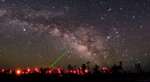 Messier Marathon
27.05.2011
In this action scene, red night vision lights, green laser pointers, tripods and telescopes in faint silhouette surround intrepid sky gazers embarked on the 10th annual Iran Messier Marathon. Completing the marathon requires viewing all 110 objects in 18th century French astronomer Charles Messier's catalog in one glorious dusk-to-dawn observing run.
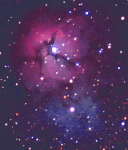 M20: The Trifid Nebula
23.07.1995
The vivid blue and violet colors present in the Trifid Nebula result from the abundance of young stars there. The light from young massive stars is quite blue and has the ability to remove electrons from surrounding gas. When these electrons re-combine with the gas, radiation rich in blue and violet light is emitted.
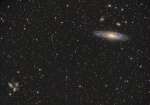 Galaxies in Pegasus
6.08.2009
This wide, sharp telescopic view reveals galaxies scattered beyond the stars at the northern boundary of the high-flying constellation Pegasus. Prominent at the upper right is NGC 7331. A mere 50 million light-years away, the large spiral is one of the brighter galaxies not included in Charles Messier's famous 18th century catalog.
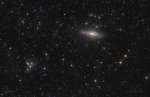 Galaxies in Pegasus
15.10.2020
This sharp telescopic view reveals galaxies scattered beyond the stars of the Milky Way, at the northern boundary of the high-flying constellation Pegasus. Prominent at the upper right is NGC 7331. A mere...
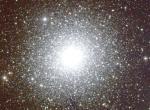 Globular Cluster M2
11.06.2001
Beneath the south pole of our Milky Way Galaxy lies a ball of over 100,000 stars. M2, the second object on Charles Messier's eighteenth century list of bright diffuse sky objects...
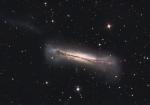 Sideways Galaxy NGC 3628
8.04.2005
Dark dust lanes cutting across the middle of this gorgeous island universe strongly hint that NGC 3628 is a spiral galaxy seen sideways. About 35 million light-years away in the northern springtime constellation...
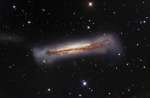 Sideways Galaxy NGC 3628
15.05.2008
Dark dust lanes cut across the middle of this gorgeous island universe, a strong hint that NGC 3628 is a spiral galaxy seen sideways. About 35 million light-years away in the northern springtime constellation...
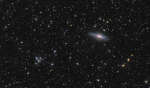 Galaxies in Pegasus
3.12.2016
This wide, sharp telescopic view reveals galaxies scattered beyond the stars of the Milky Way at the northern boundary of the high-flying constellation Pegasus. Prominent at the upper right is NGC 7331. A mere...
 Messier 2
4.04.2019
After the Crab Nebula, M1, this giant star cluster is the second entry in 18th century astronomer Charles Messier's famous list of things with are not comets. M2 is one of the largest globular star clusters now known to roam the halo of our Milky Way galaxy.
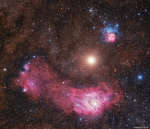 Mars Between Nebulas
27.03.2018
What that bright red spot between the Lagoon and Trifid Nebulas? Mars. This gorgeous color deep-sky photograph captured the red planet passing between the two notable nebulas -- cataloged by the 18th century cosmic registrar Charles Messier as M8 and M20.
|
January February March April May June July August |
||||||||||||||||||||||||||||||||||||||||||||||||||||||||