
|
You entered: star
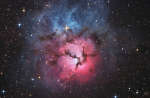 A Beautiful Trifid
19.10.2017
The beautiful Trifid Nebula is a cosmic study in contrasts. Also known as M20, it lies about 5,000 light-years away toward the nebula rich constellation Sagittarius. A star forming region in the plane...
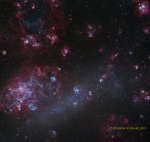 Clouds in the LMC
18.01.2018
An alluring sight in southern skies, the Large Magellanic Cloud (LMC) is seen in this deep and detailed telescopic mosaic. Recorded with broadband and narrowband filters, the scene spans some 5 degrees or 10 full moons. The narrowband filters are designed to transmit only light emitted by hydrogen, and oxygen atoms.
 Unwinding M51
20.08.2020
The arms of a grand design spiral galaxy 60,000 light-years across are unwound in this digital transformation of the magnificent 2005 Hubble Space Telescope portrait of M51. In fact...
 M1: The Crab Nebula
8.11.2023
The Crab Nebula is cataloged as M1, the first object on Charles Messier's famous 18th century list of things which are not comets. In fact, the Crab is now known to be a supernova remnant, debris from the death explosion of a massive star witnessed by astronomers in the year 1054.
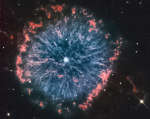 NGC 6751: The Glowing Eye Nebula
13.03.2013
Planetary nebulae can look simple, round, and planet-like in small telescopes. But images from the orbiting Hubble Space Telescope have become well known for showing these fluorescent gas shrouds of dying Sun-like stars to possess a staggering variety of detailed symmetries and shapes.
 APOD: 2025 October 3 Б Pandora's Cluster of Galaxies
2.10.2025
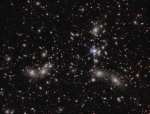
This deep field mosaicked image presents a stunning view of galaxy cluster Abell 2744 recorded by the James Webb Space Telescope's NIRCam. Also dubbed Pandora's Cluster, Abell 2744 itself appears to be a ponderous merger of three different massive galaxy clusters. It lies some 3.5 billion light-years away, toward the constellation Sculptor.
 The Whale Galaxy
2.05.2009
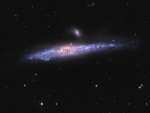
NGC 4631 is a big beautiful spiral galaxy. Seen edge-on, it lies only 25 million light-years away in the well-trained northern constellation Canes Venatici. The galaxy's slightly distorted wedge shape suggests to some a cosmic herring and to others its popular moniker, The Whale Galaxy.
 HCG 87: A Small Group of Galaxies
8.08.2015
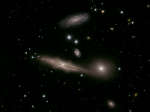
Sometimes galaxies form groups. For example, our own Milky Way Galaxy is part of the Local Group of Galaxies. Small, compact groups, like Hickson Compact Group 87 (HCG 87) shown above, are interesting partly because they slowly self-destruct.
 Retrograde Mars and Saturn
14.09.2016
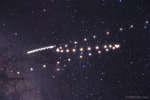
Wandering Mars and Saturn have spent much of this year remarkably close in planet Earth's night sky. In a sequence of exposures spanning mid-December 2015 through the beginning of this week, this composited...
 APOD: 2025 July 9 Б A Beautiful Trifid
8.07.2025
The beautiful Trifid Nebula is a cosmic study in contrasts. Also known as M20, it lies about 5,000 light-years away toward the nebula rich constellation Sagittarius. A star forming region in the plane...
|
January February March April May June July August September |
|||||||||||||||||||||||||||||||||||||||||||||||||