
|
You entered: stars
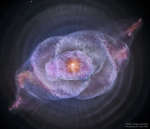 The Cats Eye Nebula in Optical and Xray
30.04.2019
To some it looks like a cat's eye. To others, perhaps like a giant cosmic conch shell. It is actually one of brightest and most highly detailed planetary nebula known, composed of gas expelled in the brief yet glorious phase near the end of life of a Sun-like star.
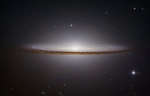 Messier 104
22.04.2022
A gorgeous spiral galaxy, Messier 104 is famous for its nearly edge-on profile featuring a broad ring of obscuring dust lanes. Seen in silhouette against an extensive central bulge of stars, the swath of cosmic dust lends a broad brimmed hat-like appearance to the galaxy suggesting a more popular moniker, the Sombrero Galaxy.
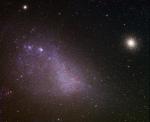 The Small Cloud of Magellan
17.06.2005
Portuguese navigator Ferdinand Magellan and his crew had plenty of time to study the southern sky during the first circumnavigation of planet Earth. As a result, two celestial wonders easily visible for southern hemisphere skygazers are known as the Clouds of Magellan.
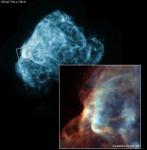 Supernova Remnant and Shock Wave
16.02.2006
A massive star ends life as a supernova, blasting its outer layers back to interstellar space. The spectacular death explosion is initiated by the collapse of what has become an impossibly dense stellar core. Pictured is the expanding supernova remnant Puppis A - one of the brightest sources in the x-ray sky.
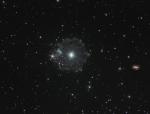 Cat s Eye Wide and Deep
29.06.2007
The Cat's Eye Nebula (NGC 6543) is one of the best known planetary nebulae in the sky. Its more familiar outlines are seen in the the brighter central region of this impressive wide-angle view. But the composite image also combines many short and long exposures to reveal the nebula's extremely faint halo.
 Visual Effects: Wonders of the Universe
18.04.2011
What visual effects are depicted in this video? The effects were created by BDH for the BBC television show Wonders of the Universe, but are unlabeled on the above version posted to Vimeo. Even...
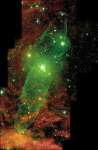 Ou4: A Giant Squid Nebula
18.07.2014
A mysterious, squid-like apparition, this nebula is very faint, but also very large in planet Earth's sky. In the mosaic image, composed with narrowband data from the 2.5 meter Isaac Newton Telescope, it spans some 2.5 full moons toward the constellation Cepheus.
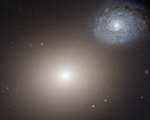 Elliptical M60, Spiral NGC 4647
27.01.2016
Giant elliptical galaxy M60 and spiral galaxy NGC 4647 do look like an odd couple in this sharp cosmic portrait from the Hubble Space Telescope. But they are found in a region of space where galaxies tend to gather, on the eastern side of the nearby Virgo Galaxy Cluster.
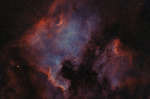 North America and the Pelican
7.09.2022
Fans of our fair planet might recognize the outlines of these cosmic clouds. On the left, bright emission outlined by dark, obscuring dust lanes seems to trace a continental shape, lending the popular name North America Nebula to the emission region cataloged as NGC 7000.
 Cat s Eye Wide and Deep
24.05.2023
The Cat's Eye Nebula (NGC 6543) is one of the best known planetary nebulae in the sky. Its more familiar outlines are seen in the brighter central region of the nebula in this impressive wide-angle view. But this wide and deep image combining data from two telescopes also reveals its extremely faint outer halo.
|
January February March April May June July August September |
|||||||||||||||||||||||||||||||||||||||||||||||||