
|
You entered: star cluster
 APOD: 2025 August 13 Б Trapezium: In the Heart of Orion
13.08.2025
What lies in the heart of Orion? Trapezium: four bright stars, that can be found near the center of this sharp cosmic portrait. Gathered within a region about 1.5 light-years in radius, these stars dominate the core of the dense Orion Nebula Star Cluster.
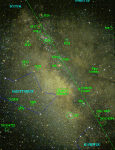 The Annotated Galactic Center
29.12.2001
The sky toward the center of our Galaxy is filled with a wide variety of celestial wonders. Many are easily visible with binoculars. Constellations near the galactic center include Sagittarius, Libra, Scorpius, Scutum, and Ophiuchus. Nebulae include Messier Objects M8, M16, M17, M20 and the Pipe Nebula.
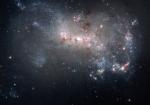 NGC 4449: Close Up of a Small Galaxy
10.07.2007
Grand spiral galaxies often seem to get all the glory. Their newly formed, bright, blue star clusters along beautiful, symmetric spiral arms are guaranteed to attract attention. But small irregular galaxies form stars too, like NGC 4449, located about 12 million light-years away.
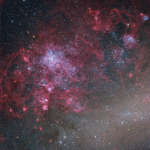 The Tarantula Zone
12.06.2014
The Tarantula Nebula is more than 1,000 light-years in diameter, a giant star forming region within our neighboring galaxy the Large Magellanic Cloud (LMC). That cosmic arachnid lies toward the upper left in this deep and colorful telescopic view made through broad-band and narrow-band filters.
 At the Core of M15
20.11.1995
Densely packed stars in the core of the globular cluster M15 are shown in this Hubble Space Telescope (HST) image taken in April of 1994. The stars revealed are contained in an area 1.6 light years across and their colors roughly indicate their temperatures - hot stars appear blue, cooler stars look reddish-orange.
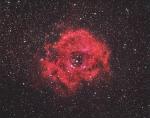 The Rosette Nebula
14.02.1998
Would the Rosette Nebula by any other name look as sweet? The bland New General Catalog designation of NGC 2237 doesn't appear to diminish the appearance of the this flowery emission nebula. Inside the nebula lies an open cluster of bright young stars designated NGC 2244.
 Clusters and Nebulae of the Hexagon
4.04.2003
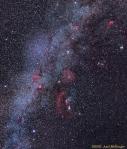
At first, the bright stars of the large asterism known as the (northern) Winter Hexagon might be hard to pick out in this gorgeous deep sky mosaic from December 2002. But placing your cursor...
 The Annotated Galactic Center
11.09.1999
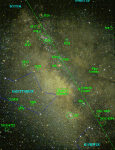
The sky toward the center of our Galaxy is filled with a wide variety of celestial wonders. Many are easily visible with binoculars. Constellations near the galactic center include Sagittarius, Libra, Scorpius, Scutum, and Ophiuchus. Nebulae include Messier Objects M8, M16, M17, M20 and the Pipe Nebula.
 The Colors and Magnitudes of M13
13.06.2019
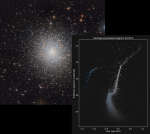
M13 is modestly recognized as the Great Globular Star Cluster in Hercules. A ball of stars numbering in the hundreds of thousands crowded into a region 150 light years across, it lies some 25,000 light-years away. The sharp, color picture of M13 at upper left is familiar to many telescopic imagers.
 Heart and Soul and Double Cluster
24.09.2016
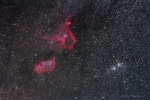
This rich starfield spans almost 10 degrees across the sky toward the northern constellations Cassiopeia and Perseus. On the left, heart-shaped cosmic cloud IC 1805 and IC 1848 are popularly known as the Heart and Soul nebulae.
|
January February March April May |
|||||||||||||||||||||||||||||||||||||||||||||||||