
|
You entered: galaxy formation
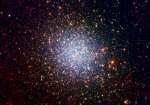 The Giants of Omega Centauri
1.05.2008
Globular star cluster Omega Centauri is some 15,000 light-years away and 150 light-years in diameter. Packed with about 10 million stars, Omega Cen is the largest of 200 or so known globular clusters that roam the halo of our Milky Way galaxy.
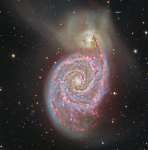 Hydrogen in M51
11.06.2010
Perhaps the original spiral nebula, M51 is a large galaxy, over 60,000 light-years across, with a readily apparent spiral structure. Also cataloged as NGC 5194, M51 is a part of a well-known interacting galaxy pair, its spiral arms and dust lanes clearly sweeping in front of companion galaxy NGC 5195 (top).
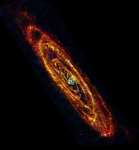 Herschel s Andromeda
2.02.2013
This infrared view from the Herschel Space Observatory explores the Andromeda Galaxy, the closest large spiral galaxy to our own Milky Way. Only 2.5 million light-years distant, the famous island universe is also known to astronomers as M31. Andromeda spans over 200,000 light-years making it more the twice the size of the Milky Way.
 An ALMA Telescope Array Time Lapse
26.05.2014
It is the most expensive and complex ground-based astronomy project ever -- what will it see tonight? The Atacama Large Millimeter Array (ALMA) project consists of 66 dishes, many the size of a small house, situated in the high altitude Atacama Desert in Northern Chile.
 The Milky Way's Gamma-Ray Halo
4.11.1997
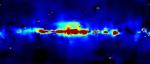
Our Milky Way galaxy appears to be surrounded by a halo of gamma rays. Gamma rays are the most energetic form of electromagnetic radiation, with more than a hundred thousand times the energy of visible light, but known gamma-ray sources don't account for the diffuse distribution of this high-energy glow.
 The Far 3kpc Arm
11.07.2008
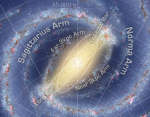
A major discovery was lurking in the data. By accident, while preparing a talk on the Galaxy's spiral arms for a meeting of the American Astronomical Society, Tom Dame (Harvard-Smithsonian CfA) found it - a new spiral arm in the Milky Way.
 COMPTEL Explores The Radioactive Sky
24.07.1996
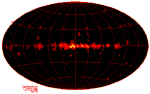
Diffuse gas clouds laced with radioactive aluminum atoms (Al26) line the plane of our Milky Way Galaxy! How do we see them? Relying on the Compton Effect, the COMPTEL instrument onboard NASA's immense orbiting Compton Gamma Ray Observatory can "see" the 1.8 million electron Volt gamma rays emitted by the radioactive decay.
 Proplyds: Infant Solar Systems?
17.10.1996
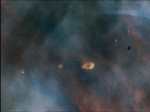
Are planets common in our galaxy? Strong evidence that the answer is "yes" was provided in this 1994 image made by the Hubble Space Telescope . A close-up of the Orion Nebulae, it reveals what seem to be disks of dust and gas surrounding newly formed stars.
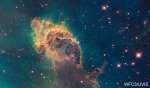 Carina Nebula Dust Pillar
7.02.2015
This cosmic pillar of gas and dust is nearly two light-years wide. The structure lies within one of our galaxy's largest star forming regions, the Carina Nebula, shining in southern skies at a distance of about 7,500 light-years.
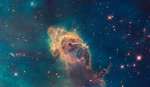 Carina Pillar and Jets
1.10.2009
This cosmic pillar of gas and dust is nearly 2 light-years wide. The structure lies within one of our galaxy's largest star forming regions, the Carina Nebula, shining in southern skies at a distance of about 7,500 light-years.
|
January February March April May June July August |
||||||||||||||||||||||||||||||||||||||||||||||||||||||||