
|
You entered: stars
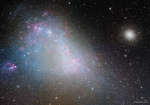 The Small Cloud of Magellan
5.01.2021
What is the Small Magellanic Cloud? It has turned out to be a galaxy. People who have wondered about this little fuzzy patch in the southern sky included Portuguese navigator Ferdinand Magellan...
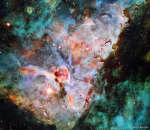 Clouds of the Carina Nebula
2.05.2021
What forms lurk in the mists of the Carina Nebula? The dark ominous figures are actually molecular clouds, knots of molecular gas and dust so thick they have become opaque. In comparison, however, these clouds are typically much less dense than Earth's atmosphere.
 APOD: 2024 October 21 Б Comet Tsuchinshan ATLAS over California
21.10.2024
The tails of Comet Tsuchinshan-ATLAS were a sight to behold. Pictured, C/2023 A3 (TsuchinshanБATLAS) was captured near peak impressiveness last week over the Eastern Sierra Mountains in California, USA. The comet not only showed a bright tail, but a distinct anti-tail pointing in nearly the opposite direction.
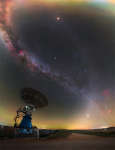 APOD: 2025 November 3 Б A Double Helix Lunar Eclipse
3.11.2025
The image was timed to capture a total lunar eclipse -- but it came with quite a twist. First, the eclipse: the fully Earth-shadowed Moon is visible as the orange orb near the top.
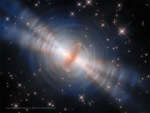 APOD: 2026 February 25 Б The Egg Nebula from the Hubble Telescope
25.02.2026
Ever wonder what it would look like to crack open the Sun? The Egg Nebula, a dying Sun-like star, can unscramble this question. Pictured is a combination of several visible and infrared images of the nebula (also known as RAFGL 2688 or CRL 2688) taken with the Hubble Space Telescope.
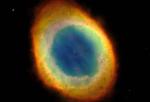 M57: The Ring Nebula
22.03.2003
Except for the rings of Saturn, the Ring Nebula (M57) is probably the most famous celestial band. This planetary nebula's simple, graceful appearance is thought to be due to perspective -- our view from planet Earth looking straight into what is actually a barrel-shaped cloud of gas shrugged off by a dying central star.
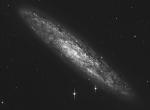 Spiral Galaxy NGC 253
21.01.1999
A camera with over 67 million pixels (digital picture elements) was used to record this stunning image of spiral galaxy NGC 253. Known as the Wide Field Imager (WFI), the camera is the latest instrument to be installed at the European Southern Observatory's 2.2 meter telescope in La Silla, Chile.
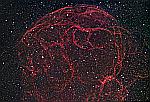 Simeis 147: Supernova Remnant
24.03.2005
It's easy to get lost following the intricate filaments in this detailed image of faint supernova remnant Simeis 147. Seen towards the constellation Taurus it covers nearly 3 degrees (6 full moons) on the sky corresponding to a width of 150 light-years at the stellar debris cloud's estimated distance of 3,000 light-years.
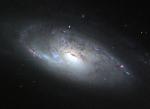 M106: A Spiral Galaxy with a Strange Core
15.02.2000
What's happening at the center of spiral galaxy M106? A swirling disk of stars and gas, M106's appearance is dominated by two bright spiral arms and dark dust lanes near the nucleus. Bright newly formed stars near their outer tips distinguish the spiral arms in the above photograph.
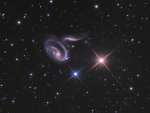 Arp 273
15.11.2008
The two prominent stars in the foreground of this colorful skyscape are well within our own Milky Way Galaxy. Their spiky appearance is due to diffraction in the astronomer's telescope. But the two eye-catching galaxies in view lie far beyond the Milky Way, at a distance of about 200 million light-years.
|
January February March April May June July August September |
|||||||||||||||||||||||||||||||||||||||||||||||||