
|
You entered: southern sky
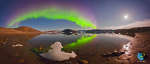 Aurora Over Greenland
23.08.2011
This aurora arched from horizon to horizon. During the current Shelios expedition to observe and learn about the northern lights, the sky last weekend did not disappoint. After sunset and some careful photographic planning, the above image was taken from the expedition's Qaleraliq campsite in southern Greenland.
 ELT and the Milky Way
15.03.2024
The southern winter Milky Way sprawls across this night skyscape. Looking due south, the webcam view was recorded near local midnight on March 11 in dry, dark skies over the central Chilean Atacama desert.
 The Nearest Stars
17.03.2001
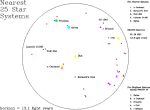
Which stars are closest to the Sun? The closest is Proxima Centauri, one of three stars that orbit each other about 4 light-years away in the Alpha-Centauri system. Alpha Centauri is easily visible from Earth's
 The Nearest Stars
21.04.1999
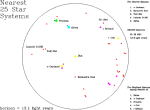
Which stars are closest to the Sun? The closest is Proxima Centauri, one of three stars that orbit each other about 4 light-years away in the Alpha-Centauri system. Alpha Centauri is easily visible from Earth's Southern Hemisphere. Next is Barnard's Star, a dim star visible with a telescope in the constellation of Ophiuchus.
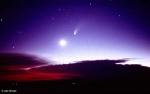 Hale-Bopp: The Crowd Pleaser Comet
9.07.1998
In 1997, the bright comet Hale-Bopp may have become the most viewed comet in history -- visible even to casual skywatchers in light polluted cities around the globe. In this picture, taken by photographer...
 The Gegenschein Over Chile
2.12.2012
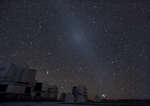
Is the night sky darkest in the direction opposite the Sun? No. In fact, a rarely discernable faint glow known as the gegenschein (German for "counter glow") can be seen 180 degrees around from the Sun in an extremely dark sky. The gegenschein is sunlight back-scattered off small interplanetary dust particles.
 The Gegenschein Over Chile
7.05.2008
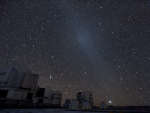
Is the night sky darkest in the direction opposite the Sun? No. In fact, a rarely discernable faint glow known as the gegenschein (German for "counter glow") can be seen 180 degrees around from the Sun in an extremely dark sky. The gegenschein is sunlight back-scattered off small interplanetary dust particles.
 Sunset on a Golden Sea
28.04.2010
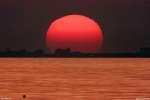
On April 17, the sky was clear and the Sun's colour was spectacular as night approached. This striking telescopic view even captures the Sun's swollen and distorted shape from the southern coast of the UK.
 A Rocket Debris Cloud Drifts
25.02.2007
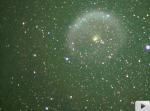
What's that cloud drifting in space? It's not an astronomical nebula -- those appear to stay put. Atmospheric clouds don't look like this. The answer to last week's sky mystery turned out to be orbiting and expanding debris from the upper stage of a failed Russian rocket that exploded unexpectedly.
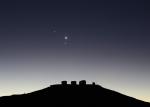 Planets over Paranal
17.08.2005
Very bright planets and very large telescopes are part of this sunset view of Paranal Observatory. The observatory's four, massive 8.2 meter telescope units are situated on top of the 2,600 meter high mountain, Cerro Paranal, in the dry Atacama Desert in northern Chile.
|
January February March April May |
|||||||||||||||||||||||||||||||||||||||||||||||||