
|
You entered: rocks
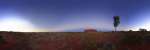 Sunset, Shadowrise
29.07.2010
From central Australia, this serene 360 degree panorama follows a clear horizon as twilight began on May 28. At left, a bright western sky is still illuminated by the setting Sun. But sweeping right...
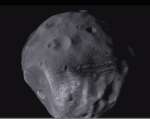 Phobos 360
25.12.2013
What does the Martian moon Phobos look like? To better visualize this unusual object, images from ESA's Mars Express orbiter have been combined into a virtual rotation movie. The rotation is actually a digital illusion -- tidally-locked Phobos always keeps the same face toward its home planet, as does Earth's moon.
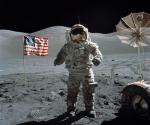 Apollo 17: Last on the Moon
16.12.2005
In December of 1972, Apollo 17 astronauts Eugene Cernan and Harrison Schmitt spent about 75 hours on the Moon, in the Taurus-Littrow valley, while colleague Ronald Evans orbited overhead. Near the beginning of their...
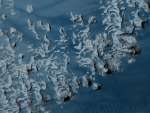 Layers in Aureum Chaos
4.04.2008
At first glance these undulating shapes in shades of blue might look like waves on an ocean. Seen here in a false-color image from the Mars Reconnaissance Orbiter's HiRISE camera, they are actually layered rock outcrops found in Aureum Chaos.
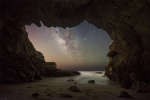 APOD: 2015 July 7 The Milky Way from a Malibu Sea Cave
6.07.2015
Whats happening outside this cave? Nothing unexpected its just the central band of our Milky Way Galaxy passing by. As the Earth turns, the band of our Galaxy appears to rotate and shift along the horizon.
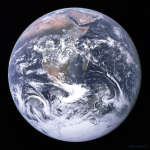 Blue Marble Earth
5.02.2022
Welcome to planet Earth, the third planet from a star named the Sun. The Earth is shaped like a sphere and composed mostly of rock. Over 70 percent of the Earth's surface is water. The planet has a relatively thin atmosphere composed mostly of nitrogen and oxygen.
 APOD: 2025 February 5 Б Comet G3 ATLAS Setting over a Chilean Hill
4.02.2025
Where is Comet ATLAS going? In the featured time-lapse video, the comet is not itself moving very much, but the Earth's rotation makes it appear to be setting over a hill. The Comet C/2024 G3 (ATLAS) sequence was captured with an ordinary camera on January 22 from the Araucanцa Region in central Chile.
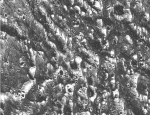 Ancient Cratered Plains on Ganymede
12.07.1996
The largest moon in the Solar System shows regions that are ancient and battered. The high density of craters demonstrate that patches of Ganymede are indeed billions of years old. This photo is one of a series released by NASA two days ago from the Galileo spacecraft orbiting Jupiter.
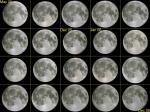 Twenty Full Moons
2.01.2007
In celebration of tonight's Full Moon, the first of 2007, consider this grid of twenty Full Moons. From upper left to lower right, the images represent every lunation from May 2005 through December 2006.
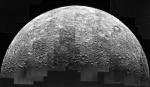 Mercury: A Cratered Inferno
1.01.1999
Mercury's surface looks similar to our Moon's. Each is heavily cratered and made of rock. Mercury's diameter is about 4800 km, while the Moon's is slightly less at about 3500 km (compared with about 12,700 km for the Earth). But Mercury is unique in many ways.
|
January February March April May June July August September |
|||||||||||||||||||||||||||||||||||||||||||||||||