
|
You entered: molecular cloud
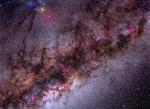 Our Galaxy in Stars, Gas, and Dust
27.09.1999
The disk of our Milky Way Galaxy is home to hot nebulae, cold dust, and billions of stars. The red nebulae visible in the above contrast-enhanced picture are primarily emission nebulae, glowing clouds of hydrogen gas heated by nearby, bright, young stars.
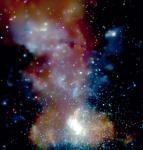 Galactic Center Star Clusters
10.08.2006
If you had x-ray vision, the central regions of our Galaxy would not be hidden from view by cosmic dust clouds. Instead, the Milky Way toward Sagittarius might look something like this. Pleasing...
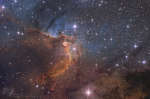 SH2 155: The Cave Nebula
5.11.2014
This colorful skyscape features the dusty Sharpless catalog emission region Sh2-155, the Cave Nebula. In the composite image, data taken through narrowband filters tracks the glow of ionized sulfur, hydrogen, and oxygen atoms in red, green, and blue hues.
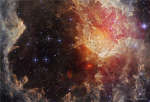 Stars and Dust Pillars in NGC 7822 from WISE
30.11.2014
Hot, young stars and cosmic pillars of gas and dust seem to crowd into NGC 7822. At the edge of a giant molecular cloud toward the northern constellation Cepheus, this glowing star forming region lies about 3,000 light-years away.
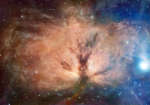 The Flame Nebula in Visible and Infrared
8.12.2014
What lights up the Flame Nebula? Fifteen hundred light years away towards the constellation of Orion lies a nebula which, from its glow and dark dust lanes, appears, on the left, like a billowing fire. But fire, the rapid acquisition of oxygen, is not what makes this Flame glow.
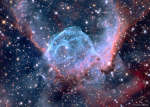 Thors Helmet Emission Nebula
1.11.2017
This helmet-shaped cosmic cloud with wing-like appendages is popularly called Thor's Helmet. Heroically sized even for a Norse god, Thor's Helmet spans about 30 light-years across. In fact, the helmet is more...
 APOD: 2025 August 1 Б Small Dark Nebula
1.08.2025
A small, dark, nebula looks isolated near the center of this telescopic close-up. The wedge-shaped cosmic cloudlet lies within a relatively crowded region of space though. About 7,000 light-years distant and filled with glowing gas and an embedded cluster of young stars, the region is known as M16 or the Eagle Nebula.
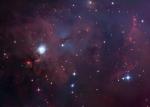 NGC 1999: South of Orion
30.01.2006
South of the large star-forming region known as the Orion Nebula, lies bright blue reflection nebula NGC 1999. The nebula is marked with a dark inverted T-shape at the lower left in a broad cosmic vista that spans over 10 light-years.
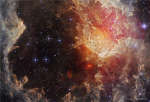 NGC 7822: Stars and Dust Pillars in Infrared
19.11.2017
Young stars themselves are clearing out their nursery in NGC 7822. Within the nebula, bright edges and complex dust sculptures dominate this detailed skyscape taken in infrared light by NASA's Wide Field Infrared Survey Explorer (WISE) satellite.
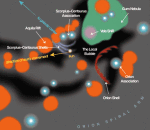 The Local Bubble and the Galactic Neighborhood
12.04.2000
What surrounds the Sun in this neck of the Milky Way Galaxy? Our current best guess is depicted in the above map of the surrounding 1500 light years constructed from various observations and deductions.
|
January February March April May |
|||||||||||||||||||||||||||||||||||||||||||||||||