
|
You entered: meteor shower
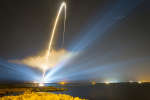 Parker vs Perseid
16.08.2018
The brief flash of a bright Perseid meteor streaks across the upper right in this composited series of exposures made early Sunday morning near the peak of the annual Perseid meteor shower.
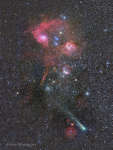 Comet, Clusters, and Nebulae
13.09.2018
Bright enough for binocular viewing Comet 21P / Giacobini-Zinner stands out, even in this deep telephoto mosaic of the star cluster and nebula rich constellation Auriga the Charioteer. On the night of September...
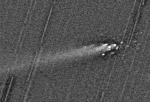 Fragments of Comet LINEAR
11.08.2000
What do you call a bunch of comet fragments anyway ... a flock, a covey, a swarm? The question is definitely relevant to comet LINEAR (C/1999 S4 LINEAR) whose nucleus apparently fragmented late last month during its first trip through the inner solar system.
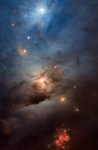 NGC 1333: Stellar Nursery in Perseus
22.04.2023
In visible light NGC 1333 is seen as a reflection nebula, dominated by bluish hues characteristic of starlight reflected by interstellar dust. A mere 1,000 light-years distant toward the heroic constellation Perseus, it lies at the edge of a large, star-forming molecular cloud.
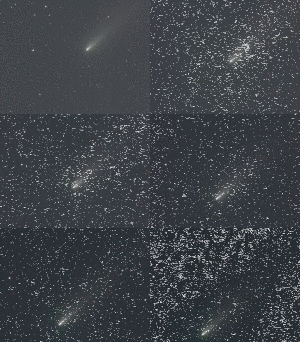 Comet Schwassmann Wachmann 3 Passes the Earth
23.05.2006
Rarely does a comet pass this close to Earth. Last week, dedicated astrofilmographers were able to take advantage of the close approach of crumbling 73P / Comet Schwassmann-Wachmann 3 to make time-lapse movies of the fast-moving comet. Large comet fragments passed about 25 times the Moon's distance from the Earth.
 A Cosmic Zoo in Cepheus
17.08.2023
Sprawling emission nebulae IC 1396 and Sh2-129 mix glowing interstellar gas and dark dust clouds in this nearly 12 degree wide field of view toward the northern constellation Cepheus the King. Energized by its central star IC 1396 (left), is hundreds of light-years across and some 3,000 light-years distant.
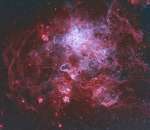 The Tarantula Nebula
16.11.2017
The Tarantula Nebula is more than a thousand light-years in diameter, a giant star forming region within nearby satellite galaxy the Large Magellanic Cloud, about 180 thousand light-years away. The largest, most violent star...
 APOD: 2024 November 27 Б The Meteor and the Comet
27.11.2024
How different are these two streaks? The streak on the upper right is Comet Tsuchinshan-Atlas showing an impressive dust tail. The comet is a large and dirty iceberg that entered the inner Solar System and is shedding gas and dust as it is warmed by the Sun's light.
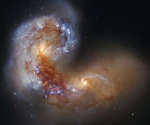 Spiral Galaxy NGC 4038 in Collision
12.08.2012
This galaxy is having a bad millennium. In fact, the past 100 million years haven't been so good, and probably the next billion or so will be quite tumultuous. Visible on the upper...
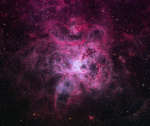 The Tarantula Nebula
17.11.2018
The Tarantula Nebula, also known as 30 Doradus, is more than a thousand light-years in diameter, a giant star forming region within nearby satellite galaxy the Large Magellanic Cloud. About 180 thousand light-years away, it's the largest, most violent star forming region known in the whole Local Group of galaxies.
|
January February March April May June July August September October |
|||||||||||||||||||||||||||||||||||||||||||||||||