
|
You entered: massive stars
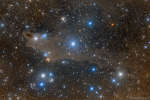 The Shark Nebula
7.09.2015
There is no sea on Earth large enough to contain the Shark nebula. This predator apparition poses us no danger, though, as it is composed only of interstellar gas and dust. Dark dust like that featured here is somewhat like cigarette smoke and created in the cool atmospheres of giant stars.
 APOD: 2023 June 14 Б The Shark Nebula
14.06.2023
There is no sea on Earth large enough to contain the Shark nebula. This predator apparition poses us no danger as it is composed only of interstellar gas and dust. Dark dust like that featured here is somewhat like cigarette smoke and created in the cool atmospheres of giant stars.
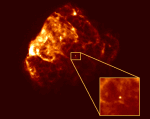 Supernova Remnant and Neutron Star
14.11.1996
A massive star ends life as a supernova, blasting its outer layers back to interstellar space. The spectacular death explosion is initiated by the collapse of what has become an impossibly dense stellar core. However, this core is not necessarily destroyed.
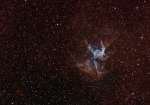 Thor s Helmet (NGC 2359) and Planetary Nebula
12.03.2009
At the right, Thor's Helmet (NGC 2359) seems to gaze across a lovely star field. The broad skyscape itself covers about 1.5 degrees or 3 full moons toward the constellation Canis Major.
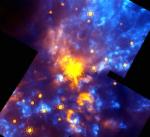 The Heart Of Orion
23.05.1997
Newborn stars lie at the heart of the Orion Nebula, hidden from view by the dust and gas of the giant Orion Molecular Cloud number 1 (OMC-1). Sensitive to invisible infrared wavelengths, Hubble...
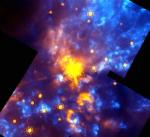 The Heart Of Orion
6.05.2000
Newborn stars lie at at the heart of the the Orion Nebula, hidden from view by the dust and gas of the giant Orion Molecular Cloud number 1 (OMC-1). Sensitive to invisible infrared...
 N81: Starbirth in the SMC
27.07.1998
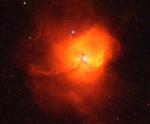
A very young star cluster has been discovered in a neighboring galaxy. The stars found in this cluster, dubbed N81, are so young and massive that they furiously eject matter and light up the surrounding nebula. The ejected stellar winds combine and interact to sculpt beautiful and complex structures.
 New Stars Destroying NGC 1748
3.04.2001
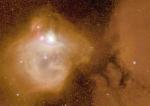
NGC 1748 cannot contain all the new stars it has formed. The young stars, the most massive of which are bright blue, emit so much energy they are pushing out and dispersing the gas and dust that comprise this star forming nebula.
 M81 and M82: GALEX Full Field
30.12.2004
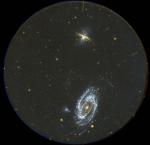
Intriguing galaxy pair M81 and M82 shine in this full-field view from the orbiting GALEX observatory. GALEX - the Galaxy Evolution Explorer - scans the cosmos in ultraviolet light, a view that follows star formation and galaxy evolution through the Universe.
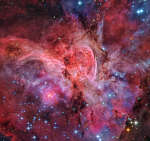 Carina Nebula Close Up
15.02.2020
A jewel of the southern sky, the Great Carina Nebula, also known as NGC 3372, spans over 300 light-years, one of our galaxy's largest star forming regions. Like the smaller, more northerly Great...
|
January February |
|||||||||||||||||||||||||||||||||||||||||||||||||