
|
You entered: magnetic field
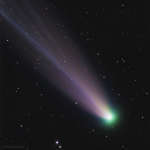 Comet Leonard Closeup from Australia
12.01.2022
What does Comet Leonard look like up close? Although we can't go there, imaging the comet's coma and inner tails through a small telescope gives us a good idea. As the name...
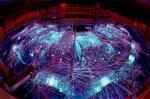 Z Machine Sets Unexpected Earth Temperature Record
13.03.2006
Why is this plasma so hot? Physicists aren't sure. What is known for sure is that the Z Machine running at Sandia National Laboratories created a plasma that was unexpectedly hot. The plasma...
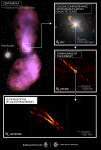 EHT Resolves Central Jet from Black Hole in Cen A
4.08.2021
How do supermassive black holes create powerful jets? To help find out, the Event Horizon Telescope (EHT) imaged the center of the nearby active galaxy Centaurus A. The cascade of featured inset images shows...
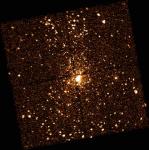 X-Ray Stars Of Orion
4.02.2000
The stars of Orion shine brightly in northern winter skies where the constellation harbors the closest large stellar nursery, the Great Nebula of Orion, a mere 1500 light-years away. In fact, the apparently bright...
 APOD: 2024 February 19 Б Looking Sideways from the Parker Solar Probe
19.02.2024
What's happening near the Sun? To help find out, NASA launched the robotic Parker Solar Probe (PSP) to investigate regions closer to the Sun than ever before. The PSP's looping orbit brings it nearer to the Sun each time around -- every few months.
 APOD: 2023 July 30 Б Spiral Aurora over Icelandic Divide
30.07.2023
Admire the beauty but fear the beast. The beauty is the aurora overhead, here taking the form of a great green spiral, seen between picturesque clouds with the bright Moon to the side and stars in the background.
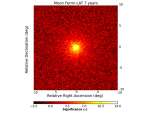 Fermi s Gamma-ray Moon
29.04.2016
If you could only see gamma-rays, photons with up to a billion or more times the energy of visible light, the Moon would be brighter than the Sun! That startling notion underlies this novel...
 APOD: 2024 December 8 Б Aurora around Saturns North Pole
8.12.2024
Are Saturn's auroras like Earth's? To help answer this question, the Hubble Space Telescope and the Cassini spacecraft monitored Saturn's North Pole simultaneously during Cassini's final orbits around the gas giant in September 2017. During this time, Saturn's tilt caused its North Pole to be clearly visible from Earth.
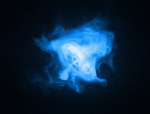 Crab Pulsar Wind Nebula
27.12.2008
The Crab Pulsar, a city-sized, magnetized neutron star spinning 30 times a second, lies at the center of this remarkable image from the orbiting Chandra Observatory. The deep x-ray image gives the first clear view of the convoluted boundaries of the Crab's pulsar wind nebula.
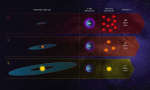 Goldilocks Zones and Stars
31.01.2020
The Goldilocks zone is the habitable zone around a star where it's not too hot and not too cold for liquid water to exist on the surface of orbiting planets. This intriguing infographic...
|
January February March April May June July August September October |
|||||||||||||||||||||||||||||||||||||||||||||||||