
|
You entered: hot star
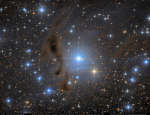 Reflections on vdB 9
21.02.2019
Centered in a well-composed celestial still life, pretty, blue vdB 9 is the 9th object in Sidney van den Bergh's 1966 catalog of reflection nebulae. It shares this telescopic field of view, about...
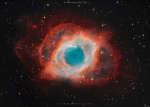 NGC 7293: The Helix Nebula
7.12.2022
A mere seven hundred light years from Earth, toward the constellation Aquarius, a sun-like star is dying. The dying star's last few thousand years have produced the Helix Nebula (NGC 7293), a well studied and nearby example of a Planetary Nebula, typical of this final phase of stellar evolution.
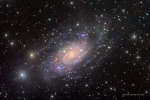 NGC 2403 in Camelopardalis
19.02.2016
Magnificent island universe NGC 2403 stands within the boundaries of the long-necked constellation Camelopardalis. Some 10 million light-years distant and about 50,000 light-years across, the spiral galaxy also seems to have more than its fair share of giant star forming HII regions, marked by the telltale reddish glow of atomic hydrogen gas.
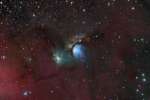 M78 Wide Field
26.11.2009
Interstellar dust clouds and glowing nebulae abound in the fertile constellation of Orion. One of the brightest, M78, is centered in this colorful, wide field view, covering an area north of Orion's belt. At a distance of about 1,500 light-years, the bluish reflection nebula is around 5 light-years across.
 R136: The Massive Stars of 30 Doradus
11.12.2005
In the center of star-forming region 30 Doradus lies a huge cluster of the largest, hottest, most massive stars known. These stars, known as the star cluster R136, and part of the surrounding nebula are captured here in this gorgeous visible-light image from the Hubble Space Telescope.
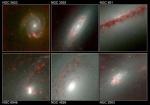 An Infrared Galaxy Gallery
22.03.1999
Where do stars form in galaxies? One way to find this out it to look for glowing hydrogen, a material common to hot star-forming regions. To find large areas of glowing hydrogen, the Hubble Space Telescope's NICMOS instrument surveyed about 100 nearby spiral galaxies.
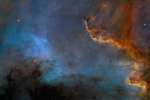 Along the Cygnus Wall
3.07.2014
The prominent ridge of emission featured in this vivid skyscape is known as the Cygnus Wall. Part of a larger emission nebula with a distinctive shape popularly called The North America Nebula, the ridge spans about 10 light-years along an outline that suggests the western coast of Mexico.
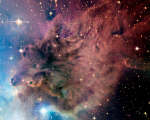 The Fox Fur Nebula from CFHT
22.04.2008
This interstellar beast is formed of cosmic dust and gas interacting with the energetic light and winds from hot young stars. The shape, visual texture, and color, combine to give the region the popular name Fox Fur Nebula.
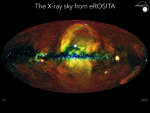 The X Ray Sky from eROSITA
23.06.2020
What if you could see X-rays? The night sky would seem a strange and unfamiliar place. X-rays are about 1,000 times more energetic than visible light photons and are produced by violent explosions and high temperature astronomical environments.
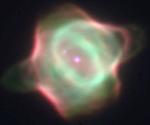 Hen 1357: New Born Nebula
3.04.1998
This Hubble Space Telescope picture shows Hen-1357, the youngest known planetary nebula. Graceful, gentle curves and symmetry suggest its popular name - The Stingray Nebula. Observations in the 1970s detected no nebular material, but this image from March 1996 clearly shows the Stingray's emerging bubbles and rings of shocked and ionized gas.
|
January February |
|||||||||||||||||||||||||||||||||||||||||||||||||