
|
You entered: galaxy formation
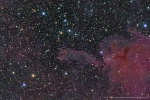 Cometary Globule CG4
5.03.2015
The faint and somehow menacing cometary globule CG4 reaches through the center of this deep southern skyscape. About 1,300 light-years from Earth toward the constellation Puppis, its head is about 1.5 light-years in diameter and its tail about 8 light-years long.
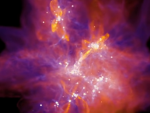 STARFORGE: A Star Formation Simulation
23.06.2021
How do stars form? Most form in giant molecular clouds located in the central disk of a galaxy. The process is started, influenced, and limited by the stellar winds, jets, high energy starlight, and supernova explosions of previously existing stars.
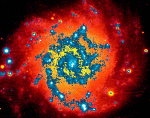 M74: A Grand Design Spiral Galaxy
9.07.1996
M74 is about the same size as our own Milky Way Galaxy. Like our Milky Way, M74 is classified a spiral galaxy. M74's sweeping lanes of stars and dust combined with its small nucleus make it a classic Grand Design Spiral. On the Hubble Sequence of Galaxies, M74 is listed as "Sc".
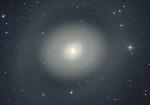 Starburst Galaxy M94
21.11.2002
What could cause the center of M94 to be so bright? Spiral galaxy M94 has a ring of newly formed stars surrounding its nucleus, giving it not only an unusual appearance but also a strong interior glow.
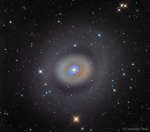 Starburst Galaxy M94
26.05.2015
What could cause the center of M94 to be so bright? Spiral galaxy M94 has a ring of newly formed stars surrounding its nucleus, giving it not only an unusual appearance but also a strong interior glow.
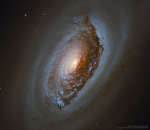 M64: The Evil Eye Galaxy
29.03.2021
Who knows what evil lurks in the eyes of galaxies? The Hubble knows -- or in the case of spiral galaxy M64 -- is helping to find out. Messier 64, also known as the Evil...
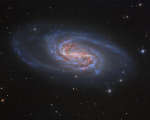 NGC 2903: A Missing Jewel in Leo
10.04.2015
Barred spiral galaxy NGC 2903 is only some 20 million light-years distant. Popular among amateur astronomers, it shines in the northern spring constellation Leo, near the top of the lion's head. That part of the constellation is sometimes seen as a reversed question mark or sickle.
 APOD: 2023 June 7 Б M94: A Double Ring Galaxy
7.06.2023
Most galaxies don't have any rings of stars and gas -- why does M94 have two? First, spiral galaxy M94 has an inner ring of newly formed stars surrounding its nucleus, giving it not only an unusual appearance but also a strong interior glow.
 APOD: 2023 May 8 Б The Spanish Dancer Spiral Galaxy
8.05.2023
If not perfect, then this spiral galaxy is at least one of the most photogenic. An island universe containing billions of stars and situated about 40 million light-years away toward the constellation of the Dolphinfish (Dorado), NGC 1566 presents a gorgeous face-on view.
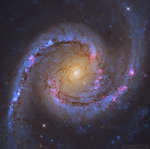 NGC 1566: The Spanish Dancer Spiral Galaxy
2.07.2019
If not perfect, then this spiral galaxy is at least one of the most photogenic. An island universe containing billions of stars and situated about 40 million light-years away toward the constellation of the Dolphinfish (Dorado), NGC 1566 presents a gorgeous face-on view.
|
January February March April May June July August |
||||||||||||||||||||||||||||||||||||||||||||||||||||||||