
|
You entered: galaxy cluster
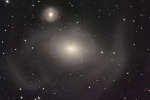 NGC 1316: After Galaxies Collide
2.09.2008
Astronomers turn detectives when trying to figure out the cause of startling sights like NGC 1316. Their investigation indicates that NGC 1316 is an enormous elliptical galaxy that started, about 100 million years ago, to devour a smaller spiral galaxy neighbor, NGC 1317, just above it.
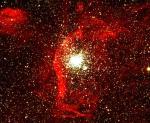 NGC 1850: Gas Clouds and Star Clusters
29.03.1999
There's nothing like it in our own Galaxy. Globular clusters as young as NGC 1850 don't exist here. Globular clusters only 40 millions of years old can still be found in the neighboring LMC galaxy, though, but perhaps none so unusual as NGC 1850.
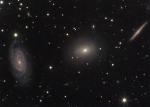 Three Galaxies in Draco
6.05.2006
This intriguing trio of galaxies is sometimes called the NGC 5985/Draco Group and so (quite reasonably) is located in the northern constellation Draco. From left to right are face-on spiral NGC 5985, elliptical galaxy...
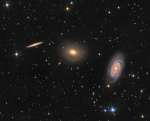 Three Galaxies in Draco
16.10.2013
This intriguing trio of galaxies is sometimes called the Draco Group, located in the northern constellation of (you guessed it) Draco. From left to right are edge-on spiral NGC 5981, elliptical galaxy NGC 5982...
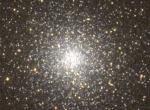 Globular Cluster 47 Tucanae
19.09.1997
Stars come in bunches. Of the over 200 globular star clusters that orbit the center of our Milky Way Galaxy, 47 Tucanae is the second brightest globular cluster (behind Omega Centauri). Known to some affectionately as 47 Tuc or NGC 104, it is only visible from the Southern Hemisphere.
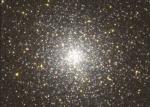 Globular Cluster 47 Tucanae
22.04.2001
Stars come in bunches. Of the over 200 globular star clusters that orbit the center of our Milky Way Galaxy, 47 Tucanae is the second brightest globular cluster (behind Omega Centauri). Known to some affectionately as 47 Tuc or NGC 104, it is only visible from the Southern Hemisphere.
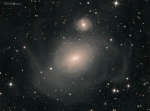 NGC 1316: After Galaxies Collide
9.09.2015
Astronomers turn detectives when trying to figure out the cause of startling sights like NGC 1316. Their investigation indicates that NGC 1316 is an enormous elliptical galaxy that started, about 100 million years ago, to devour a smaller spiral galaxy neighbor, NGC 1317, just above it.
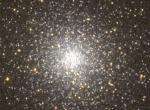 Globular Cluster 47 Tucanae
7.11.1998
Stars come in bunches. Of the over 200 globular star clusters that orbit the center of our Milky Way Galaxy, 47 Tucanae is the second brightest globular cluster (behind Omega Centauri). Known to some affectionately as 47 Tuc or NGC 104, it is only visible from the Southern
 Arp 188 and the Tadpole s Tidal Tail
2.05.2002
In this stunning vista recorded with the Hubble Space Telescope's new advanced camera, distant galaxies form a dramatic backdrop for disrupted spiral galaxy Arp 188, the Tadpole Galaxy. The cosmic Tadpole is a mere 420 million light-years distant toward the northern constellation Draco.
 Arp 188 and the Tadpoles Tidal Tail
8.01.2006
In this stunning vista recorded with the Hubble Space Telescope's Advanced Camera for Surveys, distant galaxies form a dramatic backdrop for disrupted spiral galaxy Arp 188, the Tadpole Galaxy. The cosmic tadpole is a mere 420 million light-years distant toward the northern constellation Draco.
|
January February March April May |
|||||||||||||||||||||||||||||||||||||||||||||||||