
|
You entered: disk
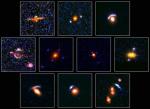 A Gallery of Gravitational Mirages
1.06.1999
The deeper you peer into the universe, the harder it is to see straight. The reason is that distant galaxies act as gravitational lenses, deflecting light that passes nearby. These deflections result in the distortion of background sources, and in some cases the creation of multiple images.
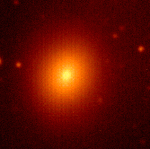 Dwarf Elliptical Galaxy M32
6.01.1996
Being the largest galaxy around can sometimes make you popular. Pictured is M31's companion galaxy M32. M31, the Andromeda galaxy, is the largest galaxy in our Local Group of galaxies - even our tremendous Milky Way Galaxy is smaller.
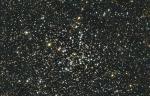 Open Star Cluster M38
7.01.2003
Open cluster M38 can be seen with binoculars toward the constellation of Auriga. M38 is considered an intermediately rich open cluster of stars, each of which is about 200 million years old. Located...
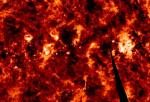 The Frothy Milky Way
2.05.1998
Astronomers have discovered that looking at dust along the plane of our Milky Way Galaxy is a bit like looking into a frothy glass of beer. The dust between stars in our galaxy appears...
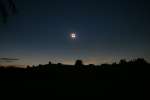 Eclipse over the Great Wall
31.08.2008
Contrary to the famous myth, you can't see the Great Wall of China from the Moon ... even during a total solar eclipse. But on August 1 you could see the Moon eclipsing the Sun from the Great Wall.
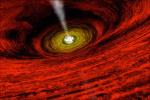 GRO J1655 40: Evidence for a Spinning Black Hole
8.05.2001
In the center of a swirling whirlpool of hot gas is likely a beast that has never been seen directly: a black hole. Studies of the bright light emitted by the swirling gas frequently indicate not only that a black hole is present, but also likely attributes.
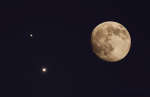 Venus and Jupiter are Close
2.07.2015
On June 30, Venus and Jupiter were close in western skies at dusk. Near the culmination of this year's gorgeous conjunction, the two bright evening planets are captured in the same telescopic field of view in this image taken after sunset from Bejing, China.
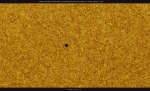 Mercury in Silhouette
13.11.2019
The small, dark, round spot in this solar close up is planet Mercury. In the high resolution telescopic image, a colorized stack of 61 sharp video frames, a turbulent array of photospheric convection cells tile the bright solar surface. Mercury's more regular silhouette still stands out though.
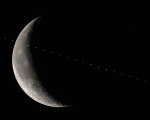 Trifecta at Twilight
20.02.2020
On February 18, as civil twilight began in northern New Mexico skies, the International Space Station, a waning crescent Moon, and planet Mars for a moment shared this well-planned single field of view. From...
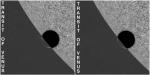 Transit of Venus Stereogram
17.07.2004
Venus glides in front of an enormous solar disk in these two frames from the TRACE satellite imaging of the inner planet's 2004 transit. Arranged in a "right/left" stereogram, the frames are intended...
|
January February March April May June July August September October November |
||||||||||||||||||||||||||||||||||||||||||||||||||||||||