
|
You entered: crescent
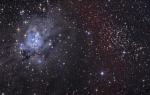 NGC 7129 and NGC 7142
13.09.2007
This alluring telescopic image looks toward the constellation Cepheus and an intriguing visual pairing of dusty reflection nebula NGC 7129 (left) and open star cluster NGC 7142. The two appear separated by only half a degree on the sky, but they actually lie at quite different distances.
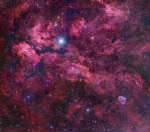 Central Cygnus Skyscape
22.03.2017
In cosmic brush strokes of glowing hydrogen gas, this beautiful skyscape unfolds across the plane of our Milky Way Galaxy near the northern end of the Great Rift and the center of the constellation Cygnus the Swan. A 36 panel mosaic of telescopic image data, the scene spans about six degrees.
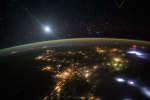 Sprites from Space
21.08.2015
An old Moon and the stars of Orion rose above the eastern horizon on August 10. The Moon's waning crescent was still bright enough to be overexposed in this snapshot taken from another large satellite of planet Earth, the International Space Station.
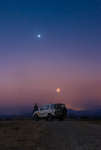 Love and War by Moonlight
16.07.2021
Venus, named for the Roman goddess of love, and Mars, the war god's namesake, come together by moonlight in this serene skyview, recorded on July 11 from Lualaba province, Democratic Republic of Congo, planet Earth.
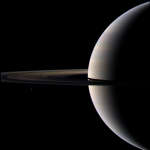 Saturn After Equinox
10.11.2009
The other side of Saturn's ring plane is now directly illuminated by the Sun. For the previous 15 years, the southern side of Saturn and its rings were directly illuminated, but since Saturn's equinox in August, the orientation has reversed.
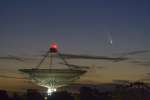 PanSTARRS over Parkes
9.03.2013
Sweeping quickly through southern skies on March 5, Comet PanSTARRS (C/2011 L4) follows the Sun toward the western horizon in this twilight scene. In the foreground is Australia's CSIRO Parkes Radio Telescope, a 64 meter wide steerable dish that is no stranger to the space age exploration of comets.
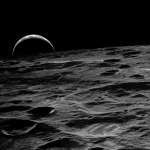 Apollo 14 Heads for Home
5.02.2021
Fifty years ago this Sunday (February 7, 1971), the crew of Apollo 14 left lunar orbit and headed for home. They watched this Earthrise from their command module Kittyhawk. With Earth's sunlit crescent just peeking over the lunar horizon, the cratered terrain in the foreground is along the lunar farside.
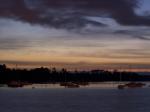 Venus Returns to the Evening Sky
9.06.2005
This serene image of boats moored in the harbor of l'нle-Tudy, Bretagne, France was taken on June 1st, about an hour after sunset. It also features Venus, third brightest celestial object after the Sun and Moon.
 Stars and Mars
10.05.2008
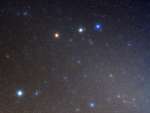
Wandering through the evening sky, on May 4th planet Mars stood in line with Castor and Pollux, the two bright stars of the constellation Gemini. In this time exposure of the celestial alignment, Mars...
 Saturn at Night
2.11.2024
Saturn is bright in Earth's night skies. Telescopic views of the outer gas giant planet and its beautiful rings often make it a star at star parties. But this stunning view of Saturn's rings and night side just isn't possible from telescopes in the vicinity of planet Earth.
|
January February March April May June July August |
||||||||||||||||||||||||||||||||||||||||||||||||||||||||