
|
You entered: blue moon
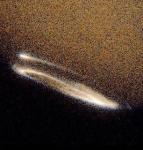 Jovian Aurora
22.01.1998
These two recently released Hubble Space Telescope close-ups show the Northern and Southern lights ... on Jupiter. Like aurora on Earth, these Jovian aurora are caused by charged particles funneled into the atmosphere above the planet's North (right) and South poles by magnetic fields.
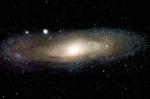 Andromeda Island Universe
8.09.2000
How far can you see? The most distant object easily visible to the unaided eye is M31, the great Andromeda Galaxy some two million light-years away. Without a telescope, even this immense spiral galaxy appears as an unremarkable, faint, nebulous cloud in the constellation Andromeda
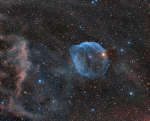 Sharpless 308: Star Bubble
30.01.2019
Blown by fast winds from a hot, massive star, this cosmic bubble is huge. Cataloged as Sharpless 2-308 it lies some 5,200 light-years away toward the constellation of the Big Dog (Canis Major) and covers slightly more of the sky than a Full Moon.
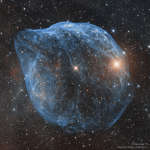 Sharpless 308: The Dolphin Nebula
1.03.2020
Blown by fast winds from a hot, massive star, this cosmic bubble is much larger than the dolphin it appears to be. Cataloged as Sharpless 2-308 it lies some 5,200 light-years away toward the constellation of the Big Dog (Canis Major) and covers slightly more of the sky than a Full Moon.
 APOD: 2025 July 9 Б A Beautiful Trifid
8.07.2025
The beautiful Trifid Nebula is a cosmic study in contrasts. Also known as M20, it lies about 5,000 light-years away toward the nebula rich constellation Sagittarius. A star forming region in the plane...
 Sharpless 308: The Dolphin-Head Nebula
20.10.2021
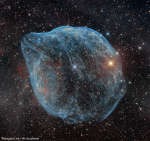
Blown by fast winds from a hot, massive star, this cosmic bubble is huge. Cataloged as Sharpless 2-308 it lies some 5,000 light-years away toward the constellation of the Big Dog (Canis Major) and covers slightly more of the sky than a Full Moon.
 Sharpless 308: The Dolphin Head Nebula
6.06.2024
Blown by fast winds from a hot, massive star, this cosmic bubble is huge. Cataloged as Sharpless 2-308 it lies some 5,000 light-years away toward the well-trained constellation Canis Major and covers slightly more of the sky than a Full Moon. That corresponds to a diameter of 60 light-years at its estimated distance.
 Grand Spiral Galaxy M81 and Arps Loop
16.04.2013
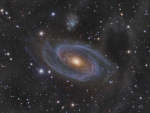
One of the brightest galaxies in planet Earth's sky is similar in size to our Milky Way Galaxy: big, beautiful M81. This grand spiral galaxy lies 11.8 million light-years away toward the northern constellation of the Great Bear (Ursa Major).
 ISS Transits Mars
22.09.2020
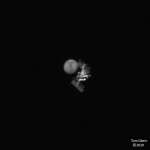
Yes, but have you ever seen the space station do this? If you know when and where to look, watching the bright International Space Station (ISS) drift across your night sky is a fascinating sight -- but not very unusual.
 M81 and Arp s Loop
8.12.2010
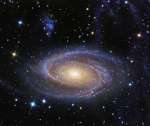
One of the brightest galaxies in planet Earth's sky and similar in size to the Milky Way, big, beautiful spiral M81 lies 11.8 million light-years away in the northern constellation Ursa Major. This...
|
January February March April May June July August |
||||||||||||||||||||||||||||||||||||||||||||||||||||||||