
|
You entered: Earth orbit
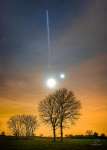 Conjunction of Four
3.02.2017
On January 31, a waxing crescent Moon, brilliant Venus, and fainter Mars gathered in the fading twilight, hanging above the western horizon just after sunset on planet Earth. In this combined evening skyscape, the lovely celestial triangle is seen through clouds and haze.
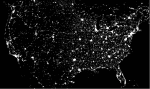 The United States at Night
17.06.1996
This is what the United States of America looks like at night! Can you find your favorite US city on this image? Surprisingly, city lights make this task quite possible. The above picture is actually a composite of over 200 images made by satellites orbiting the Earth.
 Lunation
7.11.1999
Our Moon's appearance changes nightly. This slow-loading time-lapse sequence shows what our Moon looks like during a lunation, a complete lunar cycle. As the Moon orbits the Earth, the half illuminated by the Sun first becomes increasingly visible, then decreasingly visible. The Moon always keeps the same face toward the Earth.
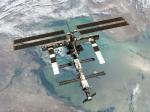 The International Space Station from Above
16.05.2006
The International Space Station (ISS) is the largest human-made object ever to orbit the Earth. Last August, the station was visited and resupplied by space shuttle Discovery. The ISS is currently operated by the Expedition 13 crew, consisting a Russian and an American astronaut.
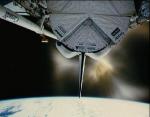 Shuttle Engine Blast
7.03.1998
The Space Shuttle Discovery's orbital maneuvering system (OMS) engine firing produced this dramatic flare as it cruised "upside down" in low Earth orbit. Discovery was named for a ship commanded by Captain James Cook RN, the 18th Century English astronomer and navigator.
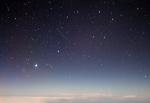 Aurigids from 47 000 Feet
5.09.2007
On September 1, Aurigid meteors filled the sky, in keeping with inovative predictions of an outburst from this historically tentative meteor shower. Astronomers flying at 47,000 feet on a dedicated mission to observer the outburst collected image data for this composite photo of the Aurigids' bright and colorful streaks.
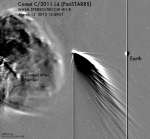 CME, Comet, and Planet Earth
15.03.2013
After appearing in a popular photo opportunity with a young crescent Moon near sunset, naked-eye Comet PanSTARRS continues to rise in northern hemisphere skies. But this remarkable interplanetary perspective from March 13, finds the comet posing with our fair planet itself - as seen from the STEREO Behind spacecraft.
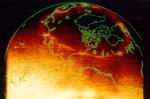 A Complete Aurora
2.04.1997
Aurora frequently make complete rings around a pole of the Earth. This particular "crown", visible in orange near the top of this image, was taken by the orbiting Polar spacecraft about one year ago and released by NASA last month.
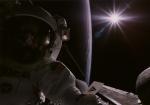 Dark Sky, Bright Sun
17.05.2003
In low Earth orbit there is not enough atmosphere to diffuse and scatter sunlight, so shadows are black and the sky is dark - even when the Sun shines. The harsh lighting produced this dramatic...
 Lunation
29.08.2004
Our Moon's appearance changes nightly. This time-lapse sequence shows what our Moon looks like during a lunation, a complete lunar cycle. As the Moon orbits the Earth, the half illuminated by the Sun first becomes increasingly visible, then decreasingly visible. The Moon always keeps the same face toward the Earth.
|
January February March April May June July August September October |
|||||||||||||||||||||||||||||||||||||||||||||||||