
|
You entered: star
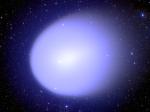 Expansive Comet Holmes
21.11.2007
The spherical coma of Comet Holmes has swollen to a diameter of over 1.4 million kilometers, making the tenuous, dusty cloud even bigger than the Sun. Scattering sunlight, all that dust and gas came...
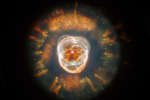 The Eskimo Nebula from Hubble
3.05.2009
In 1787, astronomer William Herschel discovered the Eskimo Nebula. From the ground, NGC 2392 resembles a person's head surrounded by a parka hood. In 2000, the Hubble Space Telescope imaged the Eskimo Nebula. From space, the nebula displays gas clouds so complex they are not fully understood.
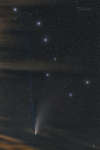 Remembering NEOWISE
31.07.2021
It was just last July. If you could see the stars of the Big Dipper, you could find Comet NEOWISE in your evening sky. After sunset denizens of the north could look for the naked-eye comet below the bowl of that famous celestial kitchen utensil and above the northwestern horizon.
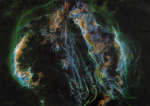 Supernova Remnant: The Veil Nebula
22.06.2022
Ten thousand years ago, before the dawn of recorded human history, a new light would have suddenly have appeared in the night sky and faded after a few weeks. Today we know this light was from a supernova, or exploding star, and record the expanding debris cloud as the Veil Nebula, a supernova remnant.
 APOD: 2023 August 22 Б The Pistachio Nebula
22.08.2023
This nebula had never been noted before. Newly discovered nebulas are usually angularly small and found by professionals using large telescopes. In contrast, the Pistachio Nebula was discovered by dedicated amateurs and, although faint, is nearly the size of the full Moon.
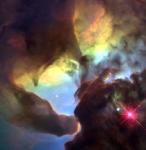 Twistin By The Lagoon
25.09.1999
The awesome spectacle of starbirth produces extreme stellar winds and intense energetic starlight -- bombarding dusty molecular clouds inside the Lagoon Nebula (M8). At least two long funnel shaped clouds, each roughly half a light-year long, have apparently been formed by this activity.
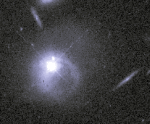 A Quasar-Galaxy Collision?
22.10.1995
In 1963 astronomers were astounded to discover that certain faint, star-like objects have very large redshifts. The large redshifts imply that these objects, now known as quasars (QUASi-stellAR objects), lie near the edge of the observable Universe.
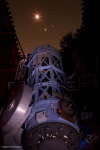 The 60 inch Reflector
13.12.2008
On the night of December 13, 1908, 100 years ago today, the 60-inch diameter reflecting telescope of Mount Wilson Observatory was first tested on the stars. It became the first successful large reflecting telescope.
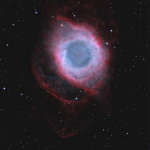 NGC 7293: The Helix Nebula
10.01.2014
A mere seven hundred light years from Earth, in the constellation Aquarius, a sun-like star is dying. Its last few thousand years have produced the Helix Nebula (NGC 7293), a well studied and nearby example of a Planetary Nebula, typical of this final phase of stellar evolution.
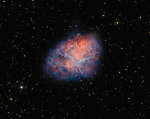 M1: The Crab Nebula
20.11.2014
The Crab Nebula is cataloged as M1, the first object on Charles Messier's famous 18th century list of things which are not comets. In fact, the Crab is now known to be a supernova remnant, debris from the death explosion of a massive star, witnessed by astronomers in the year 1054.
|
January February March April May June July August September |
|||||||||||||||||||||||||||||||||||||||||||||||||