
|
You entered: composite image
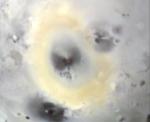 Io Volcano: Pele's Hot Lava
26.11.1999
Glowing hot lava from the heart of Io's volcano Pele is visible in this false-color infrared composite image. It was recorded last month during the Galileo spacecraft's close flyby of the Jovian moon.
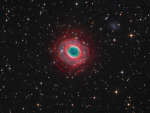 Exploring the Ring
18.09.2008
A familiar sight for northern hemisphere astronomers, the Ring Nebula (M57) is some 2,000 light-years away in the musical constellation Lyra. The central ring is about one light-year across, but this remarkably deep...
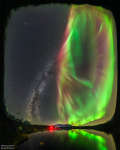 Milky Way Auroral Flower
18.10.2022
Could the stem of our Milky Way bloom into an auroral flower? No, not really, even though it may appear that way in todayБs featured all-sky image. On the left, the central plane of our home galaxy extends from the horizon past the middle of the sky.
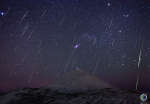 Geminid Meteors over Teide Volcano
17.12.2013
On some nights it rains meteors. Peaking two nights ago, asteroid dust streaked through the dark skies of Earth, showering down during the annual Geminids meteor shower. Astrophotographer Juan Carlos Casado captured the space weather event, as pictured above, in a series of exposures spanning about 2.3 hours using a wide angle lens.
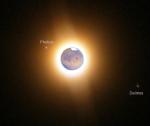 Mars Moons
24.10.2003
This year's record close approach of Mars inspired many to enjoy telescopic views of the red planet. But while Mars was so bright it was hard to miss, spotting Mars' two diminutive moons was still a good test for observers with modest sized instruments.
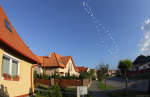 Analemma 2010
31.12.2010
Looking back on the year, have you wondered where the Sun was in the sky each day during 2010 at exacty 9am UT? Of course you have. Search no further for the answer! It was somewhere along this celestial figure 8 curve known as an analemma.
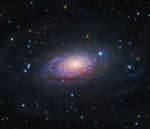 Messier 63: The Sunflower Galaxy
12.07.2017
A bright spiral galaxy of the northern sky, Messier 63 is about 25 million light-years distant in the loyal constellation Canes Venatici. Also cataloged as NGC 5055, the majestic island universe is nearly 100,000 light-years across. That's about the size of our own Milky Way Galaxy.
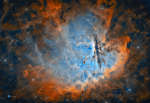 APOD: 2025 March 26 Б Star Formation in the Pacman Nebula
26.03.2025
You'd think the Pacman Nebula would be eating stars, but actually it is forming them. Within the nebula, a cluster's young, massive stars are powering the pervasive nebular glow. The eye-catching shapes...
 Massive Nearby Spiral Galaxy NGC 2841
21.04.2014
It is one of the more massive galaxies known. A mere 46 million light-years distant, spiral galaxy NGC 2841 can be found in the northern constellation of Ursa Major. This sharp view of the gorgeous island universe shows off a striking yellow nucleus and galactic disk.
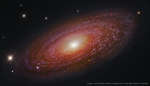 Massive Nearby Spiral Galaxy NGC 2841
28.04.2015
It is one of the more massive galaxies known. A mere 46 million light-years distant, spiral galaxy NGC 2841 can be found in the northern constellation of Ursa Major. This sharp view of the gorgeous island universe shows off a striking yellow nucleus and galactic disk.
|
January February March April May June July August September |
|||||||||||||||||||||||||||||||||||||||||||||||||