
|
You entered: active Sun
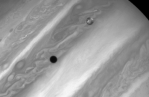 Io's Shadow
7.10.1996
Caught in the act earlier this summer by the Hubble Space Telescope, the volcanic moon Io (above and right of center) and its shadow (black dot) are seen here against Jupiter's clouds.
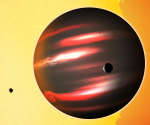 TrES 2b: Dark Planet
22.08.2011
Why is this planet so dark? Planet TrES-2b reflects back less than one percent of the light it receives, making it darker than any known planet or moon, darker even than coal. Jupiter-sized TrES-2b...
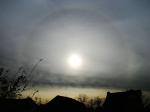 A Sun Halo Over Tennessee
9.03.2005
Sometimes it looks like the Sun is being viewed through a large lens. In the above case, however, there are actually millions of lenses: ice crystals. As water freezes in the upper atmosphere, small, flat, six-sided, ice crystals might be formed.
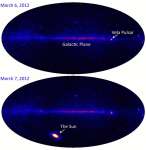 Solar Flare in the Gamma ray Sky
15.03.2012
What shines in the gamma-ray sky? The answer is usually the most exotic and energetic of astrophysical environments, like active galaxies powered by supermassive black holes, or incredibly dense pulsars, the spinning remnants of exploded stars.
 Structure in the Tail of Comet 12P/Pons Brooks
16.02.2024
Heading for its next perihelion passage on April 21, Comet 12P/Pons-Brooks is growing brighter. The greenish coma of this periodic Halley-type comet has become relatively easy to observe in small telescopes. But the bluish...
 Enceladus Creates Saturns E Ring
27.03.2007
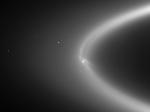
The active moon Enceladus appears to be making Saturn's E ring. An amazing picture showing the moon at work was taken late last year by the Saturn-orbiting Cassini spacecraft and is shown above. Enceladus is the bright point near the center, right near the center of Saturn's E ring.
 Tempel Tuttle: The Leonid Comet
13.11.1999
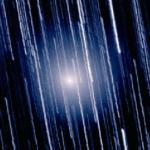
Star trails streak this composite time exposure of Comet Tempel-Tuttle recorded by T. Puckett on January 26, 1998. Then passing through the inner solar system on its 33 year orbit around the Sun, Tempel-Tuttle brightened unexpectedly, but binoculars or small telescopes were still required to visually observe it.
 Tempel-Tuttle: The Leonid Comet
30.01.1998
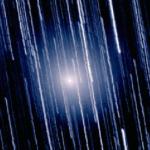
Star trails streak this composite time exposure of Comet Tempel-Tuttle recorded by T. Puckett on January 26. Presently passing through the inner solar system on its 33 year orbit around the Sun, Tempel-Tuttle has brightened unexpectedly, but binoculars or small telescopes are still required to visually observe it.
 A 2000 Leonid Through Orion
20.11.2000
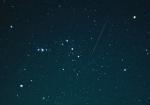
The Leonid Meteor Shower this year could be described as good but not great. During November 17 and 18 the Earth crossed through several streams of sand-sized grit left orbiting the Sun by Comet Tempel-Tuttle. Several distinct peaks in meteor activity were reported, with
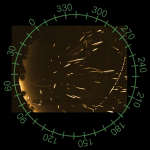 Perseids from Perseus
17.08.2009
Where are all of these meteors coming from? In terms of direction on the sky, the pointed answer is the constellation of Perseus. That is why the last week's meteor shower was known as the Perseids -- the meteors all appear to come from a radiant toward Perseus.
|
January February March April May June July August September |
|||||||||||||||||||||||||||||||||||||||||||||||||