
|
You entered: NGC catalog
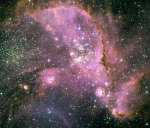 Young Stars of NGC 346
12.05.2022
The massive stars of NGC 346 are short lived, but very energetic. The star cluster is embedded in the largest star forming region in the Small Magellanic Cloud, some 210,000 light-years distant. Their...
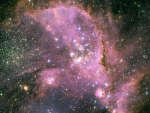 Young Stars of NGC 346
28.09.2008
The massive stars of NGC 346 are short lived, but very energetic. The star cluster is embedded in the largest star forming region in the Small Magellanic Cloud, some 210,000 light-years distant. Their...
 Along the Taurus Molecular Cloud
23.11.2023
The cosmic brush of star formation composed this interstellar canvas of emission, dust, and dark nebulae. A 5 degree wide telescopic mosaic, it frames a region found north of bright star Aldebaran on the sky, at an inner wall of the local bubble along the Taurus molecular cloud.
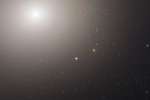 The Densest Galaxy
4.10.2013
The bright core and outer reaches of giant elliptical galaxy M60 (NGC 4649) loom large at the upper left of this sharp close-up from the Hubble Space Telescope. Some 54 million light-years away and 120,000 light-years across, M60 is one of the largest galaxies in the nearby Virgo Cluster.
 Arp 81: 100 Million Years Later
23.04.2014
From planet Earth, we see this strongly distorted pair of galaxies, cataloged as Arp 81, as they were only about 100 million years after their close encounter. The havoc wreaked by their mutual gravitational...
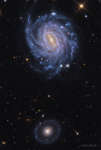 APOD: 2026 May 26 Б NGC 3660 and Burcins Galaxy
26.05.2026
The upper galaxy might be more photogenic, but the lower galaxy is more unusual. The galaxy up top is NGC 3660, a spiral galaxy similar to our own Milky Way galaxy in that it has several bright blue spiral arms and a central bar of stars, dust, and gas.
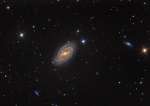 Messier 109
23.05.2013
Beautiful barred spiral galaxy M109, 109th entry in Charles Messier's famous catalog of bright Nebulae and Star Clusters, is found just below the Big Dipper's bowl in the northern constellation Ursa Major.
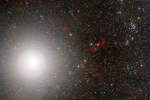 In the Glare of Alpha Centauri
28.06.2012
The glare of Alpha Centauri, one of the brightest stars in planet Earth's night sky, floods the left side of this southern skyscape. A mere 4.3 light-years distant, Alpha Centauri actually consists of two component stars similar in size to the Sun, locked in a mutual orbit.
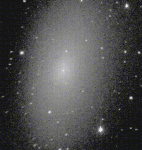 Local Group Galaxy NGC 205
8.01.1996
The Milky Way Galaxy is not alone. It is part of a gathering of about 25 galaxies known as the Local Group. Members include the Great Andromeda Galaxy (M31), M32, M33, the Large Magellanic Clouds, the Small Magellanic Clouds, Dwingeloo 1, several small irregular galaxies, and many dwarf elliptical galaxies.
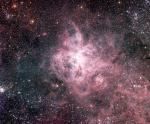 The Tarantula Zone
13.06.2002
The Tarantula Nebula is more than 1,000 light-years across - a giant emission nebula within our neighboring galaxy the Large Magellanic Cloud. Inside this cosmic arachnid lies a central young cluster of massive stars, cataloged as R136, whose intense radiation and strong winds have helped energize the nebular glow and shape the spidery filaments.
|
January February March April May June July August September |
|||||||||||||||||||||||||||||||||||||||||||||||||