
|
You entered: Milky Way
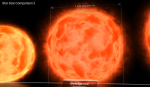 Star Size Comparison 2
12.06.2018
How big is our Sun compared to other stars? In dramatic and popular videos featured on YouTube, the relative sizes of planets, stars, and even the universe are shown from smallest to largest. The featured video begins with Earth's Moon and progresses through increasingly larger moons and planets in our Solar System.
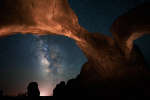 Three Arches Above Utah
24.05.2011
How many arches can you count in the above image? If you count both spans of the Double Arch in the Arches National Park in Utah, USA, then two. But since the above image...
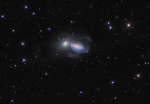 Arp 94
9.10.2013
This telescopic snapshot records a cosmic moment in the tumultuous lives of large spiral galaxy NGC 3227 and smaller elliptical NGC 3226. Catching them in the middle of an ongoing gravitational dance, the sensitive imaging also follows faint tidal star streams flung from the galaxies in their repeated close encounters.
 Over the Top
19.06.2014
The central bulge of our Milky Way Galaxy rises above a sea of clouds in this ethereal scene. An echo of the Milky Way's dark dust lanes, the volcanic peak in foreground silhouette is on France's Réunion Island in the southern Indian Ocean.
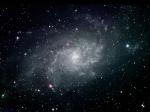 Nearby Spiral M33
14.12.2004
Spiral galaxy M33 is a mid-sized member of our Local Group of Galaxies. M33 is also called the Triangulum Galaxy for the constellation in which it resides. About four times smaller (in radius) than...
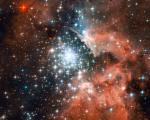 Starburst Cluster in NGC 3603
5.10.2007
A mere 20,000 light-years from the Sun lies NGC 3603, a resident of the nearby Carina spiral arm of our Milky Way Galaxy. NGC 3603 is well known to astronomers as one of the Milky Way's largest star-forming regions.
 NGC 289: Swirl in the Southern Sky
15.10.2021
About 70 million light-years distant, gorgeous spiral galaxy NGC 289 is larger than our own Milky Way. Seen nearly face-on, its bright core and colorful central disk give way to remarkably faint, bluish spiral arms. The extensive arms sweep well over 100 thousand light-years from the galaxy's center.
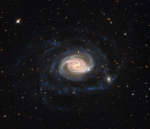 NGC 289: Swirl in the Southern Sky
5.04.2018
About 70 million light-years distant, gorgeous spiral galaxy NGC 289 is larger than our own Milky Way. Seen nearly face-on, its bright core and colorful central disk give way to remarkably faint, bluish spiral arms. The extensive arms sweep well over 100 thousand light-years from the galaxy's center.
 Constellations and Cloudy Skies
11.07.2007
Recorded earlier in July, the clouds of planet Earth reflect moonlight and a faint, reddish glow in this serene sea and skyscape. Beyond them lie the cosmic dust and star clouds of the Milky Way.
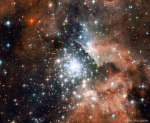 Starburst Cluster in NGC 3603
6.11.2016
A mere 20,000 light-years from the Sun lies NGC 3603, a resident of the nearby Carina spiral arm of our Milky Way Galaxy. NGC 3603 is well known to astronomers as one of the Milky Way's largest star-forming regions.
|
January February March April May June July August September October |
|||||||||||||||||||||||||||||||||||||||||||||||||