
|
You entered: Earth's moon
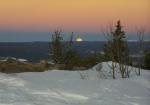 Shadow Set
27.01.2005
A nearly full Moon and planet Earth's shadow set together in this scene captured Monday from snowy Mt. Jelm, home of the Wyoming Infrared Observatory. For early morning risers (and late...
 APOD: 2024 June 17 Б Ou4: The Giant Squid Nebula
17.06.2024
Squids on Earth aren't this big. This mysterious squid-like cosmic cloud spans nearly three full moons on planet Earth's sky. Discovered in 2011 by French astro-imager Nicolas Outters, the Squid Nebula's bipolar shape is distinguished here by the telltale blue emission from doubly ionized oxygen atoms.
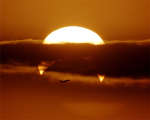 Partial Solar Eclipse with Airplane
13.05.2013
It was just eight minutes after sunrise, last week, and already there were four things in front of the Sun. The largest and most notable was Earth's Moon, obscuring a big chunk of the Sun's lower limb as it moved across the solar disk, as viewed from Fremantle, Australia.
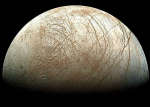 Gibbous Europa
15.12.2013
Although the phase of this moon might appear familiar, the moon itself might not. In fact, this gibbous phase shows part of Jupiter's moon Europa. The robot spacecraft Galileo captured this image mosaic during its mission orbiting Jupiter from 1995 - 2003.
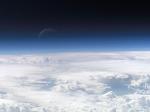 A Blue Crescent Moon from Space
20.03.2007
What's happening to the Moon? Drifting around the Earth in 2006 July, astronauts from the International Space Station (ISS) captured a crescent Moon floating far beyond the horizon. The captured above image is interesting because part of the Moon appears blue, and because part of the moon appears missing.
 Jupiter And Family
29.09.1997
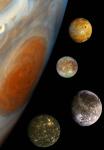
This composite image features classic portraits of members of one of the Solar System's most prominent families - Jupiter and its four large "Galilean" moons. Starting from the top the moons are Io, Europa, Ganymede, and Callisto. The top-to-bottom order is also the order of increasing distance from Jupiter.
 A Solar Eclipse with a Beaded Ring of Fire
1.03.2017
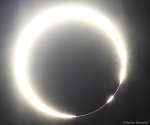
What kind of eclipse is this? On Sunday, visible in parts of Earth's southern hemisphere, the Moon blocked part of the Sun during a partial solar eclipse. In some locations, though, the effect was a rare type of partial eclipse called an annular eclipse.
 Jupiter And Family
18.11.2000
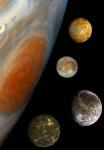
This composite image features classic portraits of members of one of the Solar System's most prominent families - Jupiter and its four large "Galilean" moons. Starting from the top the moons are Io, Europa, Ganymede, and Callisto. The top-to-bottom order is also the order of increasing distance from Jupiter.
 Mercury: A Cratered Inferno
12.09.2004
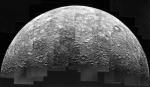
Mercury's surface looks similar to our Moon's. Each is heavily cratered and made of rock. Mercury's diameter is about 4800 km, while the Moon's is slightly less at about 3500 km (compared with about 12,700 km for the Earth). But Mercury is unique in many ways.
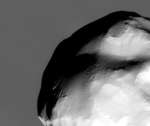 Saturns Moon Helene from Cassini
10.03.2010
What's happening on the surface of Saturn's moon Helene? The moon was imaged in unprecedented detail last week as the robotic Cassini spacecraft orbiting Saturn swooped to within two Earth diameters of the diminutive moon.
|
January February March April May June July August September |
|||||||||||||||||||||||||||||||||||||||||||||||||