
|
You entered: stars
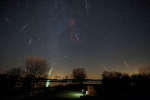 Leonids and Friends
19.11.2015
Leonid meteors rained down on planet Earth this week, the annual shower of dusty debris from the orbit of Comet 55P/Tempel-Tuttle. Leonids streak through this composite night skyview from a backyard observatory in southern Ontario.
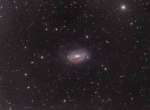 M63: Sunflower Galaxy Wide Field
3.08.2016
The Sunflower Galaxy blooms near the center of this wide field telescopic view. The scene spans about 2 degrees or 4 full moons on the sky toward the loyal constellation Canes Venatici. More formally...
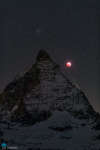 Matterhorn, Moon, and Meteor
23.01.2019
Fans of planet Earth probably recognize the Matterhorn in the foreground of this night skyscape. Famed in mountaineering history, the 4,478 meter Alpine mountain stands next to the totally eclipsed Moon. In spite...
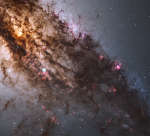 Central Centaurus A
21.02.2020
A mere 11 million light-years away, Centaurus A is the closest active galaxy to planet Earth. Also known as NGC 5128, the peculiar elliptical galaxy is over 60,000 light-years across. A region spanning about 8,500 light-years, including the galaxy's center (upper left), is framed in this sharp Hubble Space telescope close-up.
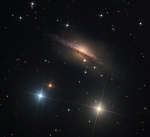 Portrait of NGC 1055
23.12.2020
Big, beautiful spiral galaxy NGC 1055 is a dominant member of a small galaxy group a mere 60 million light-years away toward the aquatically intimidating constellation Cetus. Seen edge-on, the island universe spans over 100,000 light-years, a little larger than our own Milky Way galaxy.
 APOD: 2023 October 4 Б IC 2118: The Witch Head Nebula
3.10.2023
Does this nebula look like the head of a witch? The nebula is known popularly as the Witch Head Nebula because, it is said, the nebula's shape resembles a Halloween-style caricature of a witch's head. Exactly how, though, can be a topic of imaginative speculation.
 Orionids in Taurus
25.10.2023
History's first known periodic comet, Comet Halley (1P/Halley), returns to the inner Solar System every 76 years or so. The famous comet made its last appearance to the naked-eye in 1986. But dusty...
 Portrait of NGC 1055
14.03.2024
Big, beautiful spiral galaxy NGC 1055 is a dominant member of a small galaxy group a mere 60 million light-years away toward the aquatically intimidating constellation Cetus. Seen edge-on, the island universe spans over 100,000 light-years, a little larger than our own Milky Way galaxy.
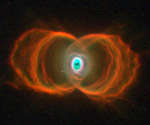 MyCn18: An Hourglass Planetary Nebula
7.08.2011
The sands of time are running out for the central star of this hourglass-shaped planetary nebula. With its nuclear fuel exhausted, this brief, spectacular, closing phase of a Sun-like star's life occurs as its outer layers are ejected - its core becoming a cooling, fading white dwarf.
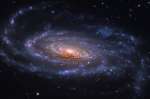 Spiral Galaxy NGC 5033
17.08.2012
Magnificent island universe NGC 5033 lies some 40 million light-years away in the well-trained northern constellation Canes Venatici. This telescopic portrait reveals striking details of dust lanes winding near the galaxy's bright core and majestic but relatively faint spiral arms.
|
January February March April May June July August September |
|||||||||||||||||||||||||||||||||||||||||||||||||