
|
You entered: NASA
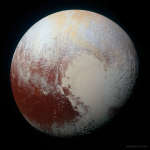 Pluto in Enhanced Color
1.08.2021
Pluto is more colorful than we can see. Color data and high-resolution images of our Solar System's most famous dwarf planet, taken by the robotic New Horizons spacecraft during its flyby in 2015 July, have been digitally combined to give an enhanced-color view of this ancient world sporting an unexpectedly young surface.
 Apollo 17: The Crescent Earth
13.05.2023
Our fair planet sports a curved, sunlit crescent against the black backdrop of space in this stunning photograph. From the unfamiliar perspective, the Earth is small and, like a telescopic image of a distant planet, the entire horizon is completely within the field of view.
 APOD: 2025 January 19 Б Titan Touchdown: Huygens Descent Movie
19.01.2025
What would it look like to land on Saturn's moon Titan? The European Space Agency's Huygens probe set down on the Solar System's cloudiest moon in 2005, and a time-lapse video of its descent images was created.
 GL 105C: The Coolest Star?
20.09.1995
Is the dim star to the upper right of this false-color picture the coolest possible normal star? From this recent picture by the Hubble Space Telescope, astronomers have estimated its mass is just high enough for it to fuse hydrogen into helium in its core.
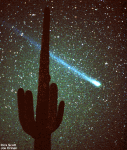 Comet Hyakutake and a Cactus
1.05.1996
Comet Hyakutake is shown photographed the night of March 27 in Arizona, USA, with a cactus in the foreground. Polaris, the north star, is the bright star seen just to the upper right of the comet's head. Today Comet Hyakutake reaches its closest approach to the Sun.
 HH1/HH2: Star Jets
19.06.1997
A cloud of interstellar gas and dust collapses and a star is born. At its core temperatures rise, a nuclear furnace ignites, and a rotating dusty disk forms surrounding the newborn star. According...
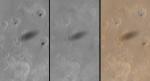 The Shadow of Phobos
17.09.2005
(xxxedit and linkxxx) Hurtling through space above the Red Planet, potato-shaped Phobos completes an orbit of Mars in less than eight hours. In fact, since its orbital period is shorter than the planet...
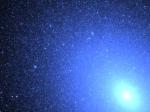 M32: Blue Stars in an Elliptical Galaxy
3.11.1999
Elliptical galaxies are known for their old, red stars. But is this old elliptical up to new tricks? In recent years, the centers of elliptical galaxies have been found to emit unexpectedly high amounts of blue and ultraviolet light.
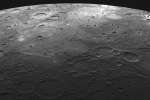 Volcanic Terrain on Mercury
27.05.2009
Why are many large craters on Mercury relatively smooth inside? Recent images from the robotic MESSENGER spacecraft that flew by Mercury last October show previously uncharted regions of Mercury that have large craters with an internal smoothness similar to the maria on Earth's own Moon.
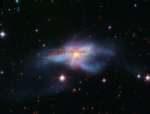 NGC 6240: Merging Galaxies
18.06.2009
NGC 6240 offers a rare glimpse of a cosmic catastrophe in its final throes. The titanic galaxy-galaxy collision is located a mere 400 million light-years away in the constellation Ophiuchus. One of the brightest...
|
January February |
|||||||||||||||||||||||||||||||||||||||||||||||||