
|
You entered: Earth
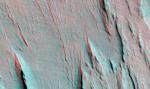 The Yardangs Of Mars
14.11.2000
OK, fans of classic science fiction might be disappointed. The yardangs are not barsoomian warriors in a newly discovered Edgar Rice Burroughs tale of adventure and conquest on the Red Planet. In fact yardangs, geologists' term for narrow, wind-eroded ridges, are common land features in the desert regions of planet Earth.
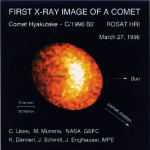 Unexpected X-rays from Comet Hyakutake
11.04.1996
The first X-rays ever detected from a comet were discovered from Comet Hyakutake with the ROSAT satellite on March 27th. The discovery is particularly surprising because there was little previous indication that comets emit any significant X-radiation.
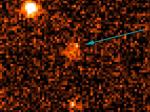 GRB Fireball Persists
17.09.1997
It's still there. The optical counterpart to the instantly famous gamma-ray burst (GRB) that occurred last February 28th has faded - but not completely. The astronomical community had waited patiently for months...
 A Powerful Solar Flare
29.10.2003
Yesterday, our Sun produced one of the most powerful solar flares in recorded history. Seen across the electromagnetic spectrum, the Sun briefly became over 100 times brighter in X-rays than normal. Over the next few days, as energetic particles emitted from these regions strike the Earth, satellite communications might be affected and auroras might develop.
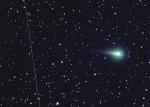 Announcing Comet C 2002 T7 LINEAR
9.02.2004
A newly discovered comet may outshine most stars in the sky by May. Designated Comet C/2002 T7 (LINEAR), the comet was discovered in 2002 October by project LINEAR. Many reports already place the comet as brighter than magnitude 7, meaning that it can now be seen with binoculars.
 Titan Disguised
21.12.2004
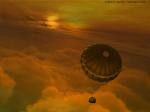
Will the Huygens probe land or splash down? In the next few days, the Cassini spacecraft currently orbiting Saturn will release a probe that will descend toward Saturn's largest moon in mid-January. That moon, Titan, has a surface normally hidden from view by thick methane cloud decks.
 Titan: Saturns Smog Moon
7.02.1999
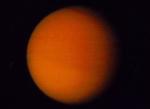
The largest moon of Saturn is a rare wonder. Titan is the only one of Saturn's moons with an atmosphere, and one of only two moons in the Solar System with this distinction (Neptune's Triton is the other).
 D rad Bacteria: Candidate Astronauts
22.01.2006
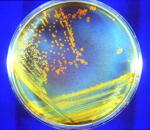
These bacteria could survive on another planet. In an Earth lab, Deinococcus radiodurans (D. rad) survive extreme levels of radiation, extreme temperatures, dehydration, and exposure to genotoxic chemicals. Amazingly, they even have the ability to repair their own DNA, usually with 48 hours. Known as an extremophile, bacteria such as D.
 Star Cluster Dreams
13.04.2006
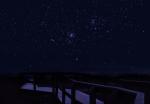
Located some 7,000 light-years away toward the constellation Perseus, this pair of open or galactic star clusters really is visible to the unaided eye and was cataloged in 130 BC by Greek astronomer Hipparchus.
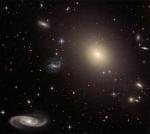 Galaxies Away
8.02.2007
This stunning group of galaxies is far, far away - about 450 million light-years from planet Earth - cataloged as galaxy cluster Abell S0740. Dominated by the cluster's large central elliptical galaxy (ESO 325-G004), this...
|
January February March April May June July August September October |
|||||||||||||||||||||||||||||||||||||||||||||||||