
|
You entered: image
 APOD: 2023 November 12 Б Gibbous Moon beyond Swedish Mountain
11.11.2023
This is a gibbous Moon. More Earthlings are familiar with a full moon, when the entire face of Luna is lit by the Sun, and a crescent moon, when only a sliver of the Moon's face is lit.
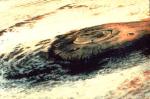 Olympus Mons on Mars: The Largest Volcano
15.09.1997
The largest volcano in the Solar System is on Mars. Olympus Mons rises 24 kilometers high and measures 550 km across. By comparison, Earth's largest volcano, Mauna Loa in Hawaii, rises 9 km high and measures 120 km across.
 The Cosmic Infrared Background
5.02.2002
What cosmic wallpaper is on the sky? The answer depends on the type of light considered, and for some wavelengths, all the cluttering material in the foreground makes it still unknown. Recently, however...
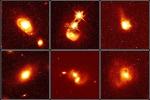 A Quasar Portrait Gallery
8.03.2002
Quasars (QUASi-stellAR objects) lie near the edge of the observable Universe. Discovered in 1963, astronomers were astounded that such objects could be visible across billions of light-years, as this implies they must emit prodigious amounts of energy. Where does the energy come from?
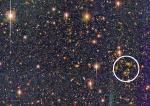 Weighing Empty Space
8.07.2002
Sometimes staring into empty space is useful. Pictured above is a region of sky that was picked because it had, well, nothing: no bright stars, no bright galaxies, and no picturesque nebulas. What could not be avoided, however, were a few stars in our own Galaxy, and many distant galaxies strewn across the universe.
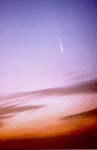 The Sun Sets on Comet Hyakutake
28.04.1996
Comet Hyakutake is seen here just as the Sun sets on April 22. As April draws to a close, Comet Hyakutake will be visible only just after sunset and will be hard to discern against the brightly lit sky.
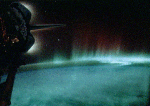 Southern Lights and Shuttle Glow
6.05.1996
A background of distant stars, sinuous and spiky bands of Southern Lights (Aurora Australis), and the faint glow of charged plasma (ionized atomic gas) surrounding the Space Shuttle Discovery's engines give this photo from the STS-39 mission an eerie, otherworldly look.
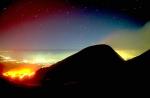 Mt Etna Lava Plumes
31.03.2003
Mt. Etna has been erupting for hundreds of thousands of years. Located in Sicily, Italy, the volcano produces lava fountains over one kilometer high. Mt. Etna is not only one of the most active...
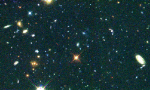 Watch Galaxies Form
5.09.1996
Snips and snails and puppy dog tails, is that what galaxies were made of? In a report released yesterday and soon to be published in Nature, astronomers have imaged an interesting distant patch of sky with the orbiting Hubble Space Telescope.
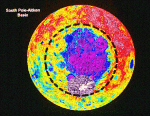 The Largest Impact Crater
6.09.1996
What is the largest known impact crater in the Solar System? Over 1300 miles across, the South Pole-Aitken Basin on the farside of Earth's Moon holds that distinction. Circled above in a false color mosaic of Clementine images it was caused when an asteroid or comet sized object crashed
|
January February March April May June July August September |
|||||||||||||||||||||||||||||||||||||||||||||||||