
|
You entered: star system
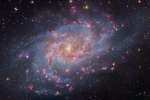 M33: The Triangulum Galaxy
2.11.2022
The small, northern constellation Triangulum harbors this magnificent face-on spiral galaxy, M33. Its popular names include the Pinwheel Galaxy or just the Triangulum Galaxy. M33 is over 50,000 light-years in diameter, third largest in the Local Group of galaxies after the Andromeda Galaxy (M31), and our own Milky Way.
 APOD: 2024 June 17 Б Ou4: The Giant Squid Nebula
16.06.2024
Squids on Earth aren't this big. This mysterious squid-like cosmic cloud spans nearly three full moons on planet Earth's sky. Discovered in 2011 by French astro-imager Nicolas Outters, the Squid Nebula's bipolar shape is distinguished here by the telltale blue emission from doubly ionized oxygen atoms.
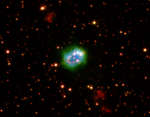 The Necklace Nebula
2.11.2010
The small constellation Sagitta sports this large piece of cosmic jewelry, dubbed the Necklace Nebula. The newly discovered example of a ring-shaped planetary nebula is about 15,000 light-years distant. Its bright ring with pearls of glowing gas is half a light-year across.
 A Solar System Portrait
5.05.1999
As the Voyager 1 spacecraft headed out of our Solar System, it looked back and took a parting family portrait of the Sun and planets. From beyond Pluto, our Solar System looks like a bright star surrounded by faint dots. In the above picture, the Sun is so bright it is blocked out for contrast.
 Arp 87: Merging Galaxies from Hubble
8.12.2015
This dance is to the death. Along the way, as these two large galaxies duel, a cosmic bridge of stars, gas, and dust currently stretches over 75,000 light-years and joins them. The bridge...
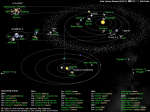 Humanity Explores the Solar System
30.04.2013
What spacecraft is humanity currently using to explore our Solar System? Presently, every inner planet has at least one robotic explorer, while several others are monitoring our Sun, some are mapping Earth's Moon, a few are chasing asteroids and comets, one is orbiting Saturn, and several are even heading out into deep space.
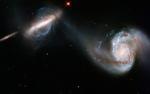 Peculiar Arp 87
31.10.2007
A cosmic bridge of stars, gas, and dust stretches for over 75,000 light-years and joins this peculiar pair of galaxies cataloged as Arp 87. The bridge is strong evidence that these two immense star systems have passed close to each other and experienced violent tides induced by mutual gravity.
 APOD: 2023 October 24 Б Arp 87: Merging Galaxies from Hubble
23.10.2023
This dance is to the death. As these two large galaxies duel, a cosmic bridge of stars, gas, and dust currently stretches over 75,000 light-years and joins them. The bridge itself is strong evidence that these two immense star systems have passed close to each other and experienced violent tides induced by mutual gravity.
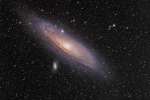 Andromeda Island Universe
8.01.2010
The most distant object easily visible to the eye is M31, the great Andromeda Galaxy some two and a half million light-years away. But without a telescope, even this immense spiral galaxy - spanning over 200,000 light years - appears as a faint, nebulous cloud in the constellation Andromeda.
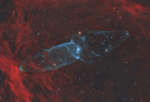 Ou4: The Giant Squid Nebula
11.10.2022
A mysterious squid-like cosmic cloud, this nebula is very faint, but also very large in planet Earth's sky. In the image, composed with 30 hours of narrowband image data, it spans nearly three full moons toward the royal constellation Cepheus.
|
January February March April May June July August |
||||||||||||||||||||||||||||||||||||||||||||||||||||||||