
|
You entered: nebula
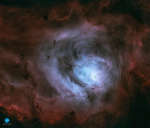 The Lagoon Nebula without Stars
8.08.2022
Ridges of glowing interstellar gas and dark dust clouds inhabit the turbulent, cosmic depths of the Lagoon Nebula. Also known as M8, the bright star forming region is about 5,000 light-years distant.
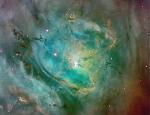 Stars and Dust of the Lagoon Nebula
8.09.2003
The large majestic Lagoon Nebula is home for many young stars and hot gas. Spanning 100 light years across while lying only about 5000 light years distant, the Lagoon Nebulae is so big and bright that it can be seen without a telescope toward the constellation of Sagittarius.
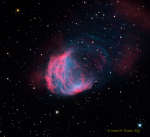 The Medusa Nebula
26.03.2021
Braided and serpentine filaments of glowing gas suggest this nebula's popular name, The Medusa Nebula. Also known as Abell 21, this Medusa is an old planetary nebula some 1,500 light-years away in the constellation Gemini. Like its mythological namesake, the nebula is associated with a dramatic transformation.
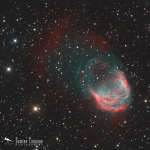 The Medusa Nebula
25.03.2022
Braided and serpentine filaments of glowing gas suggest this nebula's popular name, The Medusa Nebula. Also known as Abell 21, this Medusa is an old planetary nebula some 1,500 light-years away in the constellation Gemini. Like its mythological namesake, the nebula is associated with a dramatic transformation.
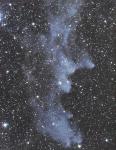 The Witch Head Nebula
29.12.2003
Double, double toil and trouble; Fire burn, and cauldron bubble -- maybe Macbeth should have consulted the Witch Head Nebula. This suggestively shaped reflection nebula is associated with the bright star Rigel in the constellation Orion.
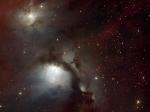 Reflection Nebulas in Orion
10.10.2006
In the vast Orion Molecular Cloud complex, several bright blue nebulas are particularly apparent. Pictured above are two of the most prominent reflection nebulas - dust clouds lit by the reflecting light of bright embedded stars. The more famous nebula is M78, near the image center, cataloged over 200 years ago.
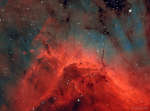 Pillars and Jets in the Pelican Nebula
3.03.2015
What dark structures arise from the Pelican Nebula? Visible as a bird-shaped nebula toward the constellation of a bird (Cygnus, the Swan), the Pelican Nebula is a place dotted with newly formed stars but fouled with dark dust.
 APOD: 2024 February 5 Б In the Core of the Carina Nebula
5.02.2024
What's happening in the core of the Carina Nebula? Stars are forming, dying, and leaving an impressive tapestry of dark dusty filaments. The entire Carina Nebula, cataloged as NGC 3372, spans over 300 light years and lies about 8,500 light-years away in the constellation of Carina.
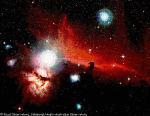 Orion's Horsehead Nebula
3.01.1999
The Horsehead Nebula is one of the most famous nebulae on the sky. It is visible as the black indentation to the red emission nebula seen just to the right of center of the above photograph. The bright star near the center is located in the belt of the familiar constellation of Orion.
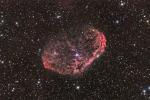 NGC 6888: The Crescent Nebula
11.11.2007
What caused the Crescent Nebula? Looking like an emerging space cocoon, the Crescent Nebula, visible in the center of the above image, was created by the brightest star in its center. A leading progenitor hypothesis has the Crescent Nebula beginning to form about 250,000 years ago.
|
January February March April May |
|||||||||||||||||||||||||||||||||||||||||||||||||