
|
You entered: magnetic field
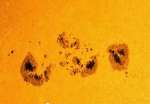 Sunspot Group AR 2339 Crosses the Sun
28.06.2015
How do sunspots evolve? Large dark sunspots -- and the active regions that contain them -- may last for weeks, but all during that time they are constantly changing. Such variations were particularly apparent...
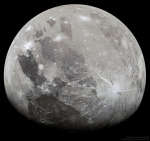 Ganymede from Juno
13.06.2021
What does the largest moon in the Solar System look like? Jupiter's moon Ganymede, larger than even Mercury and Pluto, has an icy surface speckled with bright young craters overlying a mixture of older, darker, more cratered terrain laced with grooves and ridges.
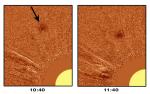 Coronal Inflow
28.11.2001
The active Sun has thrown a lot our way lately, including storms of particles streaming outward in the solar wind and clouds of plasma which triggered awesome auroral displays. Still, a growing body...
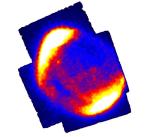 SN 1006: Pieces of the Cosmic Ray Puzzle
1.12.2000
Research balloon flights conducted in 1912 by Austrian physicist Victor Hess revealed that the Earth was constantly bombarded by high energy radiation from space - which came to be called "Cosmic Rays". What are Cosmic Rays and where do they come from?
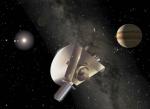 New Horizons at Jupiter
3.12.2003
Headed for the first close-up exploration of the Pluto-Charon system and the icy denizens of the Kuiper belt, NASA's New Horizons spacecraft is pictured here in an artist's vision of the robot probe outward bound.
 SDO s Multiwavelength Sun
21.12.2013
Today, the solstice is at 17:11 Universal Time, the Sun reaching the southernmost declination in its yearly journey through planet Earth's sky. The December solstice marks the astronomical beginning of winter in the northern hemisphere and summer in the south.
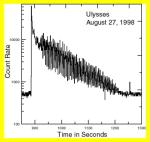 SGR 1900+14 : Magnetar
3.09.1998
On August 27th an intense flash of X-rays and gamma-rays swept through our Solar System. Five spacecraft of the Third InterPlanetary gamma-ray burst Network, Ulysses, WIND, RXTE, NEAR, and BeppoSAX, recorded the high energy...
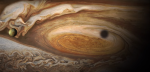 Juno Mission Trailer
27.06.2016
What will NASA's Juno spacecraft find when it reaches Jupiter next Monday? Very little, if Juno does not survive Jupiter Orbit Insertion, a complex series of operations in an unknown environment just above Jupiter's cloud tops.
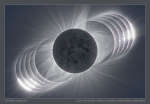 The Big Corona
30.06.2019
Most photographs don't adequately portray the magnificence of the Sun's corona. Seeing the corona first-hand during a total solar eclipse is unparalleled. The human eye can adapt to see coronal features and extent that average cameras usually cannot. Welcome, however, to the digital age.
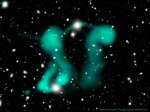 Dancing Ghosts: Curved Jets from Active Galaxies
31.08.2021
Why would galaxies emit jets that look like ghosts? And furthermore, why do they appear to be dancing? The curled and fluffy jets from the supermassive black holes at the centers of two host galaxies (top center and lower left) are unlike anything seen before.
|
January February March April May June July August September October |
|||||||||||||||||||||||||||||||||||||||||||||||||